
11. Autoclaves
With a decrease in air temperature, with an increase in altitude and a decrease in atmospheric pressure, the boiling point of water decreases. In this case, the cooking process is delayed, more fuel is consumed, and the quality of the food deteriorates.
Hermetically sealed pressure cooker pans, that is, autoclaves, in these cases help mountain tourists, skiers, and climbers to avoid all these troubles.
 |
The autoclave consists of a container body, a hermetically sealed lid with a seal, a lid locking device, a safety valve, a valve for equalizing internal and atmospheric pressure, a thermometer or pressure gauge.
Industrial pressure cookers can, in principle, be used as autoclaves, but they are small in volume and heavy. Homemade autoclaves are more suitable for travel, weigh less, have a larger volume, and are more convenient to carry. For the manufacture of autoclaves, it is advisable to use special food-grade aluminum alloys.
For a water boiling point of 110° at an altitude of about 3000 m above sea level, it is necessary to create a pressure of about 500 mm Hg in the pressure cooker. Art. (0.67 kg/cm2). The response pressure of the safety valve must therefore be no more than 0.75 kg/cm2. Based on the need for a minimum double safety factor, the test overpressure should in this case be, therefore, 1.5 kg/cm2.
Industrial aluminum pans can be used to make pressure cookers designed for an excess pressure of 0.2-0.3 kg/cm2. Therefore, the response pressure of the safety valve should be equal to 0.3-0.35 kg/cm2.
Autoclaves can have an external, pressure-type lid or an internal, self-pressing lid. Autoclaves with an internal lid may be deformed or destroyed if the safety valve fails.
The simpler autoclaves with an external lid, which were most common among tourists for a long time, were made on the basis of an aluminum household can with a “sealed” lid adapted to it. The disadvantages of these autoclaves were the small bottom area and heavy lid.
An example of such an autoclave is shown in Fig. 59. A four-piece clamp is attached to the neck of a five-liter can. Between its sections, swinging screws with wing nuts are installed on the connecting screws, which press the lid and seal the autoclave. The clamp can be made from an aluminum strip 2 mm thick. The thickness of the aluminum lid must be at least 6 mm with a food grade rubber gasket.
Autoclaves with an internal lid are less dangerous to use, since they cannot be opened without equalizing the internal pressure to atmospheric pressure. This prevents the release of steam, and sometimes the contents, when opening an overheated autoclave.
An autoclave with a welded oval-shaped body and an inner lid is shown in Fig. 60. The safety valve is installed on the removable lid of the autoclave. A fitting with a hole on the side with a diameter of 1.5-2 mm makes it possible to equalize internal and atmospheric pressure. When sealing, a cap is screwed onto the fitting. The insulated handle makes it easy to open the hot autoclave. A steel wire bow is used for carrying and hanging. It is advisable to have steel parts of the autoclave with an anti-corrosion coating. Pressure can be measured using a small car pressure gauge.
When constructing an autoclave, safety conditions must be especially strictly observed. Insufficient strength and poor quality manufacturing can lead to destruction of the autoclave due to increased internal pressure with dangerous consequences (severe burns). The finished autoclave must be checked for the maximum permissible excess pressure and the reliability of the control device (pressure gauge or thermometer) and the safety valve. The materials used in the manufacture of the autoclave must be non-toxic and corrosion-resistant.
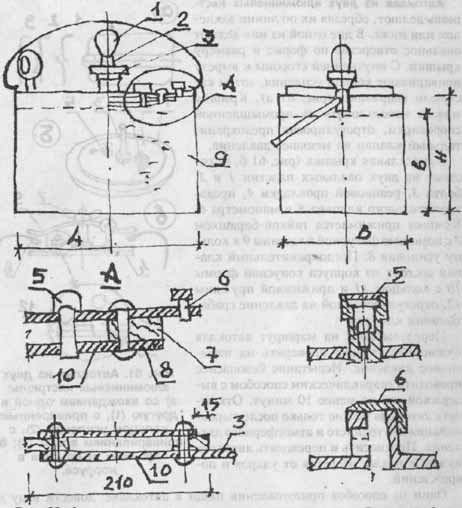
Rice. 60. Autoclave with a welded body and inner lid.
1. Heat-insulating handles. 2. M10 screw. 3. Wing nut. 4. Channel lock. 5. Safety valve. 6. Pressure release valve. 7. Rubber gasket. 8. Cover flange. 9. body. 10. Cover. II. Pressure gauge. I, I, II - length, width and height of the autoclave body, h - filling level (I." 270-320 mm. U = I5O-200 mm, H- 130-170 mm, h- 100-150 mm; volume V- 10.0 l, useful volume Un 4.0-8.3 l).
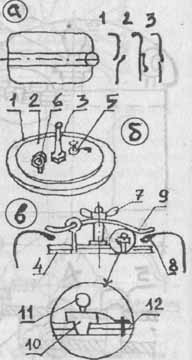 |
| Rice. 61. Autoclave made of two aluminum pans: a) with one inserting into the other (1), with a welded reinforcement ring (2), with butt welding (3); b) cover; c) cover in the housing. |
An autoclave is made from two aluminum pans by cutting them along the line of the rivets or below. An oval hole is made in the bottom of one of them according to the shape and size of the lid. A reinforcement ring is welded to the cutout from the inside, then the pans are welded (Fig. 61a). The lid can be used from an industrial pressure cooker by adjusting the safety valve to a lower pressure.
A homemade cover (Fig. 61 b, c) consists of two oval plates 1 and 2, a bolt 3, a rubber gasket 4, a safety valve 5 and a pressure gauge 6. The cover is pressed by a wing nut 7 using a shaped plate 9 to the reinforcement ring 8. The safety valve consists of a cone-shaped body 10 with a ring 11 and a pressure spring 12, adjusted on the valve response pressure.
Before leaving for a route, the autoclave must be checked for excess pressure. It is safer to carry out the test hydraulically with a holding period of at least 10 minutes. The autoclave can only be opened after the internal and atmospheric pressure have equalized. The autoclave must be carried and transported in a case, protecting it from shocks and damage.
One of the ways to cook food in an autoclave: bring water to a boil in an uncovered autoclave, add food and seal the autoclave, hold it on one or two Shmel stoves for 2-3 minutes or more, using normal pressure as a guide. Cover the autoclave removed from the stoves with thermal insulation (storm jacket, down jacket, sleeping bag) for 15-20 minutes. Carefully release excess pressure before opening the lid. Food cooked in the autoclave in the evening and covered with a down jacket remains warm until the morning.
During cooking, you can put a heat-insulating cap made of non-flammable fabric on the autoclave or cover it with a piece of such material.