
7. Tents
General requirements for any tents are light weight, waterproofness, good thermal insulation, wind resistance, quick installation and disassembly, comfort, durability, ease of carrying in a backpack, protection from midges.
The industry does not satisfy the diverse demand of tourists and climbers for tents, so most of the structures are homemade.
To make a tent, first of all you need to draw up technical specifications and determine the purpose of its future use. The designs of tents are different - from the simplest, lightweight, for easy travel, to complex frame ones.
The size of the tent floor is determined by the area needed by one person. An acceptable compromise between the comfort and weight of a tent can be considered a floor size for one person of approximately 45-50 x 200 cm. The optimal floor size for a three-four person tent is 135-150 x 200 cm and 180-200 x 200 cm. In a multi-person tent it is easier to accommodate one more person if necessary.
The height of the tent determines its comfort and windage. The higher the tent, the better its comfort, but the greater the windage. At a height of 90 cm you can only sit in a tent, at 130 cm you can kneel, at 160 cm you can stand bent over. A compromise is the height under the ridge of 140-150 cm.
The weight of the tent per person is a very important parameter. The use of nylon fabrics with a weight of no more than 150 g/m2 and high strength makes it possible to obtain a weight of less than 1 kg per person for frameless tents.
For winter and mountain hikes, double tents with a gap of 3-5 cm between the walls are often used. They are naturally warmer than single tents, but are no less than 1.5 times heavier, even if the inner tent is made of thinner and lighter fabric.
Tents can be classified:
* by season - winter and summer;
* according to travel conditions - for forest zones (taiga), for open spaces (tundra, steppes) and for mountains;
* according to the support system - frameless, installed on two racks and side braces; installed on one central support and braces; half-frame, in which the shape of the transverse section is determined by rigid elements, and the longitudinal section by end braces; frame, in which the entire configuration of the tent is provided by tension on the frame;
• for thermal insulation - single and double;
• according to the geometric shape of the vault - gable, three-, four-, six-slope, hipped (including “chum”), arched (“hangar” type), multifaceted (eight, ten sides).
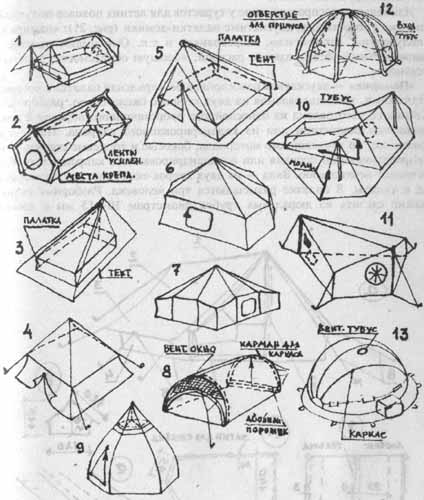 |
| Rice. 20. General view of a number of tents common among tourists of the former Soviet Union. 1. Gable. 2. “Pamirka”. 3. Three-slope. 4. Four-slope. 5. Five-slope. 6. -Septagonal tent. 7. Octagonal tent with a square base. 8. “Van”. 9. “Yurt” with an umbrella frame. 10. Uneven. 11. Double braid. 12. “Arctic”. 13. “Convertible”. |
The main type of tent for weekend hikes, as well as for hiking and water trips, can be considered gable tents in the shape of a “house”. The material for them is raincoat tarpaulin, rubberized percale (floor and roof made of water-repellent fabric), calendered nylon. The floor size is 1.3-1.5 x 1.8-2 m. Commercially available tents of this type weigh 4-5 kg, as they are made mainly of heavy (and also non-water-repellent) fabrics. A tent made of parachute nylon complete with a polyethylene cape will be much lighter.
The simplest requirements for summer tents are for forest areas. The forest itself protects from wind and sun, there is less daily temperature difference, and it is almost always possible to stretch a tent between the trees. In the forest and taiga in summer, you can hide from bad weather under a piece of fabric or film - an awning, and protect yourself from midges with a gauze canopy.
In winter, tents in the forest area are well insulated with a second inner layer; stoves for heating and cooking can be installed in them.
Tents for traveling across the steppe and tundra must withstand strong winds and protect from rain, heat, sun and cold. In winter, in treeless areas, you often have to cook food on primus stoves.
Tents for mountain travel should provide protection from rain, snow, wind and cold, ease of installation in bad weather, and the ability to cook food in inclement weather. In the mountains, it is also sometimes difficult to stretch a tent well due to the small area for installing uneven surfaces.
Some qualities of tents (wind resistance and habitability, specific material consumption, ease of installation, etc.) depend on their shape. An overview of the general appearance of tents, mostly homemade, the most common among our tourists, is presented in Fig. 20.
The simplest shelter tents include a bivouac bag, or a sack tent (Zdarsky's tent), which provides shelter, rest or overnight accommodation in a sitting or lying position. This tent is made from lightweight waterproof fabric (for example, rubberized nylon). A ventilation valve is made at the blind end of the bag. The dimensions of the bag are approximately 160 x 200 cm, weight - up to 1.5 kg. In dry weather, one climbs into the bag feet first, leaving the head exposed. In inclement weather, the bag is put on the head so that the valve is against the face. For insulation, you can put a heat-insulating cover inside the bag.
The most popular among tourists for summer hikes are, as already mentioned, gable tents-houses (Fig. 21): “pamirki”, “half-dats”, “hunting”, “serebryanki”, etc. They have a simple and rational “waste-free” cutting, good habitability, and are easy to install.
 |
| Rice. 21. Gable tent a), b) general view; c), d), e) cutting of parts; e) double seam. 1. Horse. 2. Scat. 3. Wing. 4. Vertical wall. 5. Fastening guy wires. 6. Gender 7. Stand and zipper. 8. Guys. |
“Pamirka” is a gable, single-layer, frameless tent with eight guys, installed on two poles (preferably collapsible). The roof is made of single-layer rubberized percale with aluminum coating or calendered nylon. The floor is made of the same, but two-layer material, the side and end walls are made of non-rubberized percale or non-calendered nylon, which provides ventilation. The entrance is made of two panel doors, fastened with brakes. The tent accommodates three people. Collapsible racks can be made from duralumin tubes with a diameter of 10-15 mm and a length of 40-50 cm. Pegs can be made from light duralumin corners, plastic, and wire pins.
The tent is intended mainly for summer hikes; for winter and mountain hikes it is not warm enough, does not have a sealed entrance, condensation collects on the inside of the roof. When it snows, the slopes sag under the weight of the snow, reducing the interior space of the tent.
Less known are lean-to tents. They are just as easy to cut, they are very comfortable in the forest, but they are less resistant to winds.
A simple lean-to tent with a rectangular base can be made from different materials (Fig. 22).
 |
| Rice. 22. Single-pitch tent 1. Slope. 2. Side wall. 3. Wing. 4. Vertical wall. 5. Fastening guy wires. 6. Gender 7. Stand and zipper. 8. Guys. |
One option: the slope is made of ordinary, and the walls are made of calendered nylon. For strength, the slope is stitched along the perimeter and diagonals with nylon tape. To protect from rain, a polyethylene awning is used in such a way that a vestibule is formed in front of the entrance for things. If you also make a ramp from calendered nylon, you can do without an awning. The entrance has a clasp - “burdock” or with a zipper.
For 6 people, the recommended floor dimensions are 2 x 3 m, the height of the front wall is 1.2 m and the back wall is 0.5-0.6 m. The total weight of the tent is about 2.6 kg (tent - 1.2 kg, poles and pegs - 0.5 kg, awning - 0.9 kg).
Three-slope tent.
Waterproof fabric is used for the roof and bottom, and nylon mesh 1 is used for the front wall (Fig. 23). Half a meter from it, a canopy is sewn from two overlapping halves (parachute nylon, chintz), the second can be tied to the walls of the tent with ribbons, regulating the access of fresh air. In cold weather the canopy is lowered. The frame is assembled inside the tent and consists of a vertical pole, a ridge and an L-shaped rear pole. The front stack can also be made L-shaped. For a prefabricated frame, duralumin tubes 10-16 x 1 mm long up to 60 cm are suitable. A total of 10 tubes are needed. Nylon loops are sewn to the bottom of the tent, into which pegs are inserted. No awning needed.
 |
| Rice. 23. Three-slope tent 1. Nylon mesh. 2. Calico canopy. 3. Zipper closure. 4. Frame. |
They sleep in a tent facing the entrance. These dimensions are given to accommodate three to four people. The weight of the tent is about 4 kg.
Single tents have one significant drawback: with waterproof slopes, the end and side walls of the tent, even if they are made of breathable material, sweat. On the internal relatively cold surfaces of the slopes, condensation forms, falling from the moist warm air. The greater the temperature difference between the outside and inside air, the more condensation forms. Therefore, in single tents it is advisable to keep the door leaves open whenever possible.
The air layer of a double tent (Fig. 24 a), primarily on the roof, will give the effect of thermal insulation, as a result of which there is no longer such a temperature difference on its inner surface as in a single tent. The effect of ventilation of this air layer itself is created by using the movement of outside air - a weak wind (Fig. 24 b) or natural convection with the gradual release of the upper heated part of this air (Fig. 24 c).
Therefore, the most advanced tents are made double. The outer tent is made of waterproof fabric, the inner one is made of lightweight fabric.
If the roof of the tent gets wet, then an awning is additionally needed - preferably made of lightweight non-calendered nylon or polyethylene film, which is best stretched so that there is a gap between it and the roof of the tent for better ventilation. The awning should cover the entire tent with a margin. The strength of the awning is tested in the wind.
 |
| Rice. 24. Ventilation schemes for double-layer tents or tents with an awning |
A tent made of nylon fabrics must be sewn with nylon threads, guy ropes must be sewn to reinforcing nylon reinforcement tapes. Parts of nylon tents must be melted along the contour so that the edge seams do not unravel.
In areas with warm, dry climates, a large awning of 3 x 2.5 m or 4 x 3 m can provide shelter for six people. In this case, you can do without a tent (Fig. 5). An awning, like a tent, must have 8 guys. The attachment points for the guy ropes are reinforced. The awning, like a tent, can be gable or single-pitch (sloping to one side) with a top edge height of up to 2 m.
However, tents-houses, for all their simplicity and light weight, are inconvenient in autumn or winter at low temperatures. At this time, larger tents of a different type for 9-12 people are better suited, where the whole group can fit.
The table below compares one-, two-, three- and four-slope tents (Fig. 25).
Pyramid three-pitch tents are lighter than single-pitch and double-pitch tents, require less material, resist winds better, are easier to install, but more difficult to manufacture.
The capacity of a tent of the same length (usually 2 m) is determined by its width. For normal recreation, the width of the floor per person should be about 50 cm. Fabric consumption and the associated cost and weight of the tent naturally depend on its size and design.
A tent with an awning made of well-chosen material is only slightly heavier, but provides more reliable protection from rain, cold, and sun. The awning can be used separately, without a tent.
Sometimes, in bad weather, you have to spend a significant amount of time in a tent. Therefore, it is important that you can sit in it (the comfort zone should have a height of at least 85-90 cm).
 |
| Rice. 25. Schemes of one-, two-, three-m hipped tents. |
To protect against midges and improve ventilation, a canopy made of gauze or thick tulle is hung at the entrance.
The following materials are most often used for tents:
• tent canvas (260 g/m2);
• raincoat fabric (200 g/m2);
• percale (60-100 g/m2);
• nylon (40-50 g/m2);
• waterproof materials - rubberized duplicated percale (“fabric 500”, 250 g/m2);
• calendered nylon (100 g/m2).
For awnings, polyethylene film is also used (50-100 g/m2),
Three-slope tents are the most economical in terms of fabric consumption: a two- to four-person tent requires on average 2 m2 of fabric less than a gable tent (and taking into account the awning - 5 m2); the weight is correspondingly 10-20% less. The comfort zone in a three-slope tent can be increased by adding 10-20 cm in height.
A single three-slope tent 80 cm wide (back wall 50-60 cm), made of percale, weighs 0.6-0.8 kg with guys.
A lean-to tent is suitable for hiking in forest areas. It is easy to manufacture, has a large comfort zone and entrance area. If you pull down the front wall, the tent can accommodate two or three more people.
For mountain travel, a three-slope tent with an entrance width of 1.4-1.5 m is acceptable. If you sleep with your head towards the entrance, you can narrow the back wall to 1.2 m, which will reduce the weight and windage of the tent. It is better to make the roof of tents used in the mountains waterproof, since awnings are inconvenient here - they increase weight, windage, the number of pegs for stretching, and complicate installation in strong winds. A ventilation sleeve with a diameter of 10-15 cm is sewn into the very top of the tent. Compared to the “pamirka”, this tent is lighter, easier to install and has one pole.
To prevent condensation from forming on the roof in cold weather, gauze is hung under it, which can be easily dried separately from the tent.
In strong winds, it is better to use L-shaped racks, which prevent side winds from pushing through the walls and make entry more free.
A three-slope chamber with an awning may be preferred for open spaces (tundra, steppe). In this case, the awning must be lowered to the ground and closed in front and behind.
A gable awning reaching to the ground is convenient for single-pitch and double-pitch tents. However, this increases windage, weight, installation time, and the number of fastening pegs.
Table 1 below shows the weight data for raincoat fabric: dense percale weighs half as much, nylon weighs four times as much. Tent fabric and rubberized duplicated percale weigh 30% more than raincoat fabric, and calendered nylon (of different densities) does not exceed this in weight. (The denominator of the table shows the fabric consumption taking into account the awning).
A two-layer tent retains heat well. The outer tent is attached to the inner tent using ties or elastic bands with hooks. The gap between the outer and inner tents is 50-80 mm, which provides an air-insulating layer. Both tents can be used separately.
The tents are stitched with nylon reinforcement tapes along the diagonal of the slope. The guy wire loops are attached to the corners and centers of the slopes, floors, and roof ridges. Two tube entrances allow you to place tents close to the entrance or with a vestibule. The vestibule is secured using buttons sewn every 15-20 cm to the tent. The depth of the vestibule is 1-1.5 m. The walls have a reserve for gates (20-30 cm), which are pressed down with things. It is better to make the slopes of the outer tent from calendered nylon (can be made from silver or bologna), the walls and ends are made from dense nylon. The inner tent is made from lighter (parachute) nylon or percale.
The weight of a complete tent (with vestibules, collapsible poles, polyethylene under the tent and an awning over the roof) is about 4 kg.
 |
| Rice. 26. Tent “Taiga”. |
Tent “Taiga”. Designed for hiking in wooded areas (Fig. 26). It differs from traditional “houses” in the asymmetrical slopes - the roof ridge is shifted to one side. This increases the comfort of the tent: you can sit in a higher part, place a stove and firewood there. The entire area under the gentle slope is a bedroom.
The sagging of the slopes, especially during heavy snowfalls, can be reduced with the help of additional guys sewn to the centers of the slopes. The entrance is made in the form of a tube or with a zipper. The zipper is fastened from top to bottom. A fabric strip is sewn on the inside along the entire length of the zipper, which somewhat reduces the penetration of cold air.
The pipe opening is covered with fiberglass or a plate of durable foil is inserted. It is good to sew the seams, especially along the lines of maximum tension, with nylon tape (sling).
The tent can be made from thin canvas, tent fabric or safari fabric. The walls and ends can also be made from Bologna. When setting up a tent, it is advisable to use trees and bushes; in open forests, turn the long slope towards the wind, and protect the low wall with a snow bank or snow bricks. You can stretch a cord under the ridge inside the tent and dry clothes, socks, and shoes on it.
The dimensions shown in the diagram provide comfortable seating for six people.
Table I
Characteristics of some types of tents for summer and mountain hikes (according to A. Korobkov)
| Type of tent | Capacity | Width | Height | Floor area | Fabric consumption | Specific fabric consumption per sq. m of floor | Weight | Spring person | Entrance area | Comfort zone | |
| without awning | with awning | ||||||||||
| people | м | м | sq.m | sq.m | sq.m | sq.m | кг | кг | sq.m | hmm | |
| Single-pitch | 2 | 1,3 | 1,3 | 2,6 | 11,4 | 17,4 | 4,3/6,7 | 2,3 | 1,15 | 2,6 | 0,5х2 |
| 4 | 2 | — | 4,0 | 17,4 | 24,4 | 4,4/6,1 | 3,5 | 0,88 | — | 1,1х2 | |
| Gable | 1 | 0,6 | 0,7 | 1,2 | 5,6 | — | 4,2 | 1.0 | 1,0 | 0,27 | — |
| 1 | 0,8 | 1,0 | 1,6 | 7,5 | — | 4,6 | 1,5 | 1,5 | 0,5 | — | |
| 1—2 | 1,0 | 1,0 | 2,0 | 8,5 | 14,5 | 4,2/7,3 | 1,7 | 1,7 | 0,65 | — | |
| 2 | 1,3 | 1,3 | 2,6 | 10,5 | 16,5 | 4,0/6,4 | 2,1 | 1,0 | 0,96 | 0,4х2 | |
| 3 | 1,5 | 1,5 | 3,0 | 13,0 | 19,5 | 4,3/6,5 | 2,6 | 0,88 | 1,5 | 0,7х2 | |
| 4 | 2,0 | 1,8 | 4,0 | 17,2 | 25,2 | 4,3/6,3 | 3,5 | 0,86 | 2,3 | 1х2 | |
| Three-slope | 1 | 0,6 | 0,7 | 1,2 | 4,4 | — | 3,7 | 0,9 | 0,9 | 0,27 | — |
| 1 | 0,8 | 1,0 | 1,6 | 6,2 | — | 3,9 | 1,25 | 1,25 | 0,5 | — | |
| 1—2 | 1,0 | 1,0 | 2,0 | 7,0 | 10,5 | 3,5/5,3 | 1,4 | 1,4 | 0,65 | — | |
| 2 | 1,3 | 1,3 | 2,6 | 8,7 | 13,7 | 3,3/5,3 | 1,75 | 0,88 | 0,96 | 0,1х0,9 | |
| 3 | 1,5 | 1,5 | 3,0 | 11,5 | 17,0 | 3,8/5,6 | 2,3 | 0,75 | 1,5 | 0,7х1,0 | |
| 4 | 2,0 | 1,8 | 4,0 | 15,0 | 21,5 | 3,7/5,4 | 3,0 | 0,75 | 2,3 | 1х1,2 | |
| Four-slope | 4 | 2.0 | 1,8 | 4,0 | 14,4 | — | 3,6 | 2,9 | 0,72 | — | 1х1 |
 |
| Rice. 27. Tent “Taimyrka”. |
Tent “Taimyrka”. Tents for outdoor spaces, especially in northern tundra regions, must satisfy many complex and conflicting requirements.
During the polar day, when the sun does not set around the clock, the temperature sometimes reaches 25-30", decreasing slightly at night. The lack of vegetation does not make it possible to protect the tent from the sun and strong winds. The winds tend to set the tent on fire, and due to the looseness of the soil, it is not possible to firmly anchor it everywhere, so you need to achieve low windage of the tent.
The lack of fuel in the tundra forces the use of primus stoves, lighting them and using them in bad weather in a tent. Therefore, the shape and dimensions of the tent should ensure its sufficient comfort.
The proposed design (Fig. 27) consists of a durable but lightweight awning and a tent made of light, breathable material (percale, canvas, chintz). By changing the gaps between the awning and the tent, you can create the necessary thermal insulation and protect yourself from the sun and wind.
Tent tents have the lowest windage, however, with a low side wall height, it is difficult to ensure waterproofness of the entrance and good ventilation in the heat. Therefore, a tent with one pole offset towards the exit is more suitable here. The awning slopes down to the ground from the entrance and protects it from the wind. Between the awning and the entrance of the tent - the vestibule - you can place a kitchen in bad weather, between the walls and the awning - wet clothes, food, etc.
It is advisable for a tent to have a waterproof entrance with a threshold, since in the tundra you often have to set up camp in a deserted place. You can lay plastic film under the tent.
The entrance of the tent is fastened with a zipper or a “burdock.” By adjusting the length of the awning's guy ropes, the gap between it and the tent is changed. In windy, cold weather the awning is lowered to the ground.
For 4-6 people, the floor dimensions are 1.6-2.1 x 1.8-2 m. The height of the walls is no less than 30-35 cm (otherwise comfort worsens) and no more than 45-50 cm (otherwise windage increases). The height of the central pillar is 1.35-1.8 m. At a higher height, windage and material consumption increase, but comfort increases and ventilation improves.
The most rational sizes of a tent for 4-6 people: length and width 2 m; height 1.75 m; the weight of a tent made of percale is 1.4 kg, parachute nylon is 0.7-0.8 kg, the weight of an awning made of calendered nylon is 1.1-1.5 kg.
There are additional requirements for winter tents. They must accommodate the entire group, have increased strength, wind resistance, and be able to install stoves and stoves.
 |
| Rice. 28. Designs of winter tents: a) frameless on a central support; b) frame; b) semi-frame “fungi”. 1. “Chum.” 2. “Tent”. 3. “Leningradskaya”. 4. “Arctic”. 5. “Hangar”. |
There are the following main designs of tents for winter hiking: frameless on a central support, half-frame and frame (Fig. 28).
The first group includes all “soft” tents, “chum” type tents and numerous tents. These are basically lightweight tents. They are often installed using skis and ski poles.
The second group is associated with the use of a central support; and an umbrella mushroom top. The panel placed on this fungus is secured without fixing the edges with rigid elements.
The third group uses various frames, creating a shape close to a hemisphere and, with additional braces, providing ground resistance to any wind. The absence of a central support makes for easy placement. The disadvantages of such tents are the large mass of the frame (up to 1.5 kg), the complexity of manufacturing, the need (in some designs) to put the shell on top of the frame, which can be difficult to do in strong winds. “Frame tents are more durable and stable, they allow better use of space due to a cylindrical or spherical arch. Tubes made of light aluminum alloys are best suited for the frame.
On simple hikes, you can use tetrahedral tarpaulin tents or two “pamirs” sewn from the ends with a tube entrance.
The openings for the chimney are framed with an insert made of asbestos fabric or fiberglass.
Here are several designs of homemade tents that have been tested in operation.
An eight-blade tent for a group of 9-12 people, having a diameter of 3.5-4 m, a height of vertical walls up to the tent part of 0.7 m, a height at the top of 1.8-2 m, weighs 6 kg if made of a raincoat tarpaulin. Made from thick nylon, this tent weighs 3-4 kg. The tent can be used in glued and treeless areas - it is wind-resistant. For strength, the ribs of such a tent are reinforced with sewn-in nylon laces or feet. On winter hikes, you can use an awning to insulate and reduce frostbite, but it is better to make a two-layer tent - then the awning looks like it’s inside it.
 |
| Rice. 29. “High-rise” gable and two-layer tents: a) 1st structure, internal part; b) 2nd design. |
“High-altitude” gable and two-layer tents. The first design is designed for 4 people (Fig. 29 a). Can be used with central or semi-framed versions with L-shaped tubular duralumin posts inserted into the edges of the roof panels. This ensures cross-sectional rigidity. The roof of the outer tent is made of calendered nylon; the walls, floor and inner tent are made of thin parachute nylon (for example, from a brake parachute). To increase strength, nylon tape is cross-sewn onto the slopes.
In the centers of the slopes at the intersections of the tape, additional ties are made to prevent them from sagging under the weight of the snow.
The tent has an entrance in the form of a retractable sleeve.
Tent dimensions: outer - floor - 210 x 160 cm, height - 160 cm, inner - floor - 200 x 150 cm, height - 150 cm; total weight _ 3 kg
The second design of a similar gable wind-resistant tent for 3-4 people for mountain travel is shown in Fig. 29 b.
The inner tent is made of thin parachute nylon and the floor is made of decorlan. The awning is also made of decorlan and completely covers the inner tent, forming two vestibules at the entrance.
The inner tent is attached to rings sewn to the awning with nylon tapes, which extend from its attachment points.
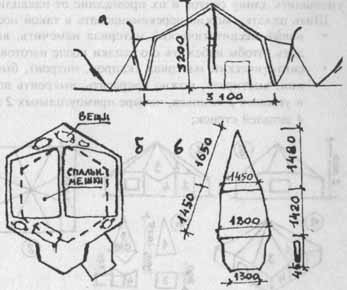 |
| Rice. 30. Hexagonal tent: a) general view; b) top view, placement in a tent; c) cutting the wedges. |
The tent and awning are transported together. Guy lines are connected to loops sewn to the tent using shock absorbers, which significantly increases the stability of the tent in strong winds. The L-shaped middle wall eliminates sagging of the ridge and side slopes of the awning.
Advantages of gable tents: ease of cutting fabric and making frames, comfortable conditions inside.
Disadvantages: a large number of guy ropes and their weakening during long-term parking.
Hexagonal tent (Fig. 30) without a floor. Designed for the given sizes for 6 people. There is space for a stove (primus stove) and things.
The seven-sided tent (Fig. 31) is designed for these sizes for 6 people. Due to the angles on the sides, the area increases slightly. Wind resistance is enhanced when installed with the tetrahedral side facing the wind.
An octagonal tent on a square base (Fig. 32). It differs from other tents by pairing a multifaceted top with a square (possibly rectangular) base. This floor shape provides a larger usable area compared to a round floor. This allows you to sit more comfortably in the tent. The walls can be made vertical or inclined up to 15°. This allows you to somewhat reduce the length of the slopes and their sagging from accumulating snow.
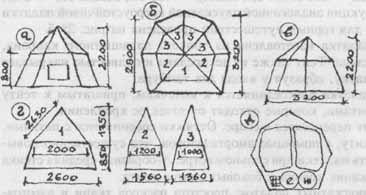 |
| Rice. 31. Seven-sided tent: a) general view; b) top view; c) side view; d) cutting wedges; e) option to accommodate six people; f) a place for a stove and stoves; g) place for things. |
It is recommended to sew a tent in the following order:
• wet, dry and iron new non-synthetic material to avoid shrinkage after making the tent;
• synthetic material (nylon, nitron), used, washed, can be painted, cut out four middle 1 and corner 3 wedges, four rectangular 2 and eight figured 4 wall parts;
• cut out and sew a tube to one of the middle walls;
• to the corner slope, which will be to the left of the entrance, sew a ventilation tube and a hole for the stove pipe with a lining made of heat-resistant fabric;
• sew wedges and walls;
• temporarily sew the panels together using simple threads, starting from the “g” point, to the top and floor;
• sew temporary loops and braces;
• set up a tent; mark the places of sagging and folds, and then re-stitch these places;
 |
| Rice. 32. Octagonal tent on a square base: a) general view; b) view from the entrance; c) view from an angle; d) top view; e) cutting the slopes (1, 3) and walls (2, 4). |
• reinstall the tent and make sure that all fabrics are stretched without wrinkles, folds or sagging;
• sew the edges with nylon threads using a linen seam and turn the tent inside out so that all seams are inside;
• sew a reinforcement cone from the inside for the central support, loop and guy wire;
• cut and sew the bottom of the tent, if you decide to have a tent with a bottom; if the tent is designed without a bottom, the wall parts (2 and 4) are made 20 cm longer (100 cm instead of 80 cm).
The tent can comfortably accommodate 6 people. The wind resistance of the tent can be ensured by using a windproof wall made of snow blocks.
Decagonal tent “Winter” (Fig. 33). This is an industrial tent designed for winter hiking (Solnechnogorsk Mechanical Plant). The increased number of edges brings the shape of the tent closer to a circle in plan, which, in combination with a wall of snow bricks, makes it possible to withstand strong winds. The almost vertical walls allow you to be placed almost close to them, the height allows you to stand in the tent.
 |
| Rice. 33. Decahedral tent “Winter”: a) general view; b) top view; c) cutting wedges; d) the option of placing a group in two to four sleeping bags. |
This tent can be set up on two skis tied together as a central pole. Guys can also be attached to 10 skis and the same number of poles to secure the edges. The entrance to the tent is tube (hole with a sleeve). To protect against frost that may form on the inside of the tent, a second layer of material is hung over 2/3 of the area of the tent.
You can sew a tent yourself according to the drawings provided, making it more compact, but designed, like an industrial one, to accommodate 8-10 people. The tent comes with a floor and weighs 6 kg.
Six-sided tents for mountain routes. The proposed designs make it possible to increase the comfort zone and increase wind resistance with minimal material consumption and weight.
The first version of the “tent house” is designed for two people (Fig. 34 a). The shape of the bottom is somewhat narrowed towards the legs (they sleep with their heads towards the exit), and the back wall is lower than the front.
The tent is installed on an L-shaped collapsible pole, which is located inside the tent along the contour of the ABZDE. The side racks are always kept in special pockets. The ends of the racks can protrude slightly below the floor in order to stick into the ground and fix it. The weight of such a tent made of parachute nylon does not exceed 1 kg. If the slopes are made from calendered nylon, the weight will increase to 1.5 kg.
 | 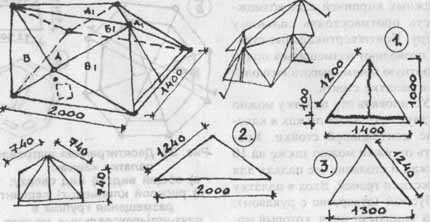 |
| Rice. 34. Six-sided tents for mountain routes: from above - a) tent house - 1. Side view. 2) View from the entrance. 3. Top view; bottom – b) decahedron – 1. Front wall with zippers. 2) Side slopes (A, A1), side walls (B, B1). 3. Side wedges (B, B1, D, D1). |
The six-slope tent according to the second option (Fig. 34 b) is installed on four posts. In the mountains, ice axes are suitable as side stands, and in winter conditions, ski poles or extended alpen poles are suitable.
Patterns are shown without seam allowances. Before cutting the wedges, it is useful to pre-sew nylon tapes along oblique lines, which will prevent the material from stretching and increase the strength of the tent.
Eight triangles of two sizes are cut out for the slopes and side walls. Pockets can be sewn to the side walls from the inside.
Sewing sequence: sew wedges A and A1, sew wedges B and B1 to wedge A, and D and D1 to wedge A1; sew side wedges B and B1, end and side loops for guy lines, front and back walls, then sew on the floor and bottom loops.
 |
| Rice. 35. Cone or ten-sided tent. 1. Ventilation tube. 2. Entrance tube. 3. Loops. |
A ten-sided tent on a central support (a homemade version of the “Winter” tent) can be made as a tent or, more simply, as a cone. The difference is that the edge of a tent is bent. A cone tent is easier to make; snow rolls off from these edges more easily. A negative feature is some loss of usable area due to the relatively acute angle between the slope and the bottom.
The tent version (Fig. 35) of the tent increases the usable area due to the almost vertical walls and thereby creates some convenience: you can sit close to the walls, which frees up the center. When setting up a tent, you have to fix the edges by appropriately tilting guy ropes or using ski poles.
The entrance is made in the form of a tube with a diameter of 80-90 cm, tightened with a nylon cord, at the top there is a ventilation tube with a diameter of 15 cm. The bottom is made of thin parachute fabric, which allows you not to distort the perimeter during installation. The height of the tent is 2 m, the consumption of dense nylon is 21-22 m2, the total weight of the tent is 3.6 kg. To avoid freezing of the inside of the tent or the formation of frost, it is advisable to attach a cone made of thin parachute nylon under the slopes of the tent.
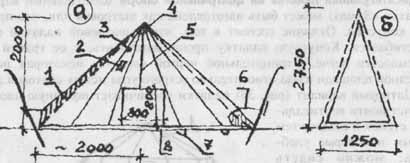
The frameless ten-sided tent “Chum” in appearance resembles a tent or yaranga (Fig. 36). The tent is easy to make, has good wind resistance, and is quick to set up. Snow almost never settles on these slopes. In addition to the reinforcement tape for the perimeter of the tent for the treeless tundra version of the tent, the same reinforcement tapes, to which loops for additional guys can be attached, can be made at a height of 50 cm and 120 cm. When using additional guys, the volume of the tent increases, its strength and wind resistance. The entrance of the tent is made in the form of a sleeve-tube. The height of the tent is 2 m, the diameter is 4 m, the wedge triangle measures 125 cm at the base and 275 cm in height; wedges - 10.
 |
| Rice. 36. Frameless ten-sided tent “Chum”: a) general view; 6) cutting the wedge. 1. Increasing the volume by stretching the slopes. 2. Heat-resistant material with a hole for the stove pipe. 3. Ventilation tube. 4. Gain cone. 5. Support. 6). Guys. 7. Ski loops. 8. Tent perimeter reinforcement tape. |
For treeless areas, the tent is made of calendered nylon. It is possible to attach an inner tent made of thin parachute nylon, which makes the tent warmer and protected from frost formation.
Weight of nylon tent: single - 3.5 kg, double - 5.5 kg. For taiga regions, such a tent is made of thin tarpaulin with a hole for a stove pipe. The weight of a single tent is about 5.5 kg. A tent without a floor is designed for 7-9 people.
As already noted, it is useful to sew additional guy ropes onto the tent (approximately at a distance of 1/3-1/2 of the slope from the vertical part). These guys can be tied around the handle of the stick and tied to the ski if there is no windproof wall (Fig. 37 a). If there is a windproof wall, it is recommended to tie the guys to skis installed directly next to the wall (Fig. 37 b). In this case, the shape of the top of the tent is closer to spherical and guy lines work better.
 |
| Rice. 37. Storm guy lines. 1. Standard guy lines. 2. Storm guy lines. 3. Snow wall. 4. Oblique support of two skis. 5. Mat pads. 6. Birthday boy (saucepan, snow shovel). |
In a very strong wind, approaching a storm, to protect the tent from tearing, you can make an oblique support from skis inside the tent and fix it, and put a shock absorber (mat, etc.) between the end of the ski and the slope of the tent (Fig. 37 c).
If this measure turns out to be insufficient and there is a threat of the tent bursting, all that remains is to lower the central support, twist and press the slopes and wait out the bad weather.
Pop-frame tent (Fig. 38). Its supporting elements are the central pillar and the umbrella frame. The frame consists of six radial tubes 1, mounted on a sliding star 4 on a vertical stand 4 and radial inclined braces 3 made from a cord. The braces are attached to flange 5 and the ends of the radial tubes. The open umbrella is fixed by adapter coupling 6, the upper end of which has a union nut with an M16 thread, and the lower end rests on a central post 1550-1600 mm long. You can use two skis clamped with clamps as a stand. Clutch 6 rests on the upper clamp.
When setting up a tent, the ends of the radial tubes of the open umbrella are inserted from the inside into special pockets in the corners of the tent dome, then a stand is placed, the canvas is straightened, its lower edges are fixed on hinges with ski poles and pressed down with snow. Then guys are tied to the skis.
 |
| Rice. 38. Half-frame tent: a) top star; b) coupling. 1. Radial tubes. 2. Articulation with coupling. 3. Radial inclined braces made from cords. 4. Vertical rack. 5. Flange (a). 6. Transition coupling. |
The radial tubes with a diameter of 10-12 mm are made of duralumin, the vertical stand is made of a titanium tube with a diameter of 13-15 mm. The star is machined from titanium. Frame weight 0.9-1 kg.
Tent “Leningradskaya”. A simple and lightweight frame tent. Its frame consists of a collapsible umbrella part and skis used for lateral supports. A tent panel without a floor is placed on top of the frame (Fig. 39 a).
A tent can have 6-10 sides depending on its size. The side edges are inclined to the base at an angle of 50°, the roof has an inclination to the horizon of 15-20°. The collapsible umbrella frame consists of radial tubes 1, and the other ones are put on the tee pin 4. Perimeter tubes 3 are inserted into the tees and secured with a clamp 5. The tee has a bracket 8 for the toe of the ski and pin 7 for fixing the dome.
In the folding version of the frame, all radial tubes are hinged to the central sprocket and have stops that limit their rotation to 15-20° to the horizon. Perimeter tubes with tees are attached as in the collapsible version.
The central sprocket assembly can be made simpler (Fig. 39 b) if all radial tubes 1 have a tab 2 at one end with a hole bent at an angle of 15-20°, and a clamp 3 at the other. The tabs are threaded on a pin 4 with a diameter of 8-10 mm and are fastened with a nut to a wing 5. Instead of a tee, an elbow 6 is used, onto which the clamp 3 is put. radial tube. The difference in level between the upper and lower tabs at the top of the umbrella, as well as some misalignment of the radial tubes, are insignificant.
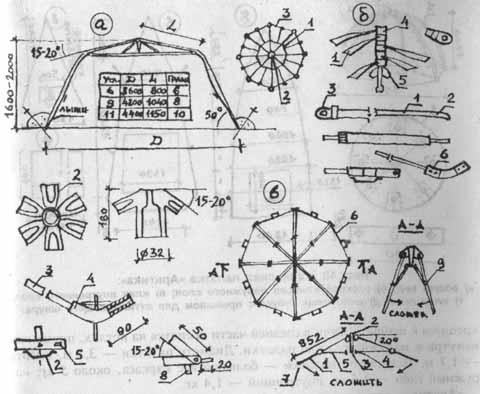 |
| Rice. 39. Tent “Leningradskaya”. a) frame (1. Radial tubes. 2. Central sprocket. 3. Perimeter tubes); b) a simplified version of the central sprocket assembly; c) a variant of a folding umbrella frame. |
Another version of the folding umbrella frame (Fig. 39 c) consists of radial tubes 1 connected to a sprocket 2, which is mounted on the upper part of the pipe 3. The lower sprocket 4 with attached struts 5 moves along the branch pipe, the second ends of the struts are connected to the radial tubes, which are tightened with a thin cable 6. Loops 7 from the same are attached to the end of the radial tubes cables for ski tips. The same loops are located on the perimeter in the middle of the span. The cable in each span is fixed with a copper tube coupling. The open umbrella is fixed with a pin through the hole in the pipe. The design allows you to install the tent on the central support without skis. The umbrella can be made more convenient to carry if the radial tube is made of two elbows connected by a hinge. The folded bundle of tubes will in this case be thicker, but shorter.
The radial tubes of the latest design are made of duralumin with a diameter of 14 mm and a thickness of 1 mm, the struts are 12 mm and 1 mm, respectively. The sprockets are made of 2.5 mm thick duralumin alloy, the hinges 9 are made of 1.2 mm thick titanium. Steel cable, 1.8 mm in diameter, in a case made of vinyl chloride tube. The weight of the structure is 1.8 kg.
Frame two-layer tent “Arctic” (Fig. 40). The frame is made in the form of eight beams 1 of duralumin tubes with a diameter of 12 mm and a thickness of 1.5 mm. Each beam consists of three parts, the upper parts are attached to washer 2. The beams in the middle part are attached to loops sewn from the inside to the outer layer of the tent. The diameter of the tent is 3.5 m, the height is 1.7 m. The disadvantage of the tent is the heavy weight of the frame, about 5 kg; outer layer - 4.5 kg, inner layer - 1.4 kg.
“Arctic” is recommended for hiking in polar regions if it can be transported rather than carried in a backpack.
 |
| Rice. 40. Frame tent “Arctic”: a) general view; b) cutting the wedges of the outer layer; c) wedge of the inner layer; d) floor wedge; e) tube panel with stitching for a pull cord. |
Frame tent “Hangar” is a double tent of a wagon or wagon type (Fig. 41). The roof of the outer tent is made of calendered nylon, the end walls and floor are made of thin parachute nylon. The floor of the inner tent is made of bologna type fabric, everything else is made of parachute nylon. Entrances are located at both ends (sleeves that are tightened in the outer tent and panels that are fastened with hooks on the inner tent).
The cross-sectional shape is given by three collapsible arches made of duralumin tubes - two at the ends and one along the middle section of the tent. The ends of the arches are inserted into rings on reinforcing tapes sewn to the floor. The arches are inserted into loops sewn to the arch.
The tent is six-seater, or, if necessary, eight-seater, placed crosswise in it, which makes all places equal in terms of convenience.
The shape of the arch of this tent reduces the windage and increases the internal volume. There is practically no condensation in it due to the double walls. Snow is easily shaken off from the inside by increasing the steepness of the arch. The tent is more comfortable compared to a gable tent.
Dimensions of the six-person version of the tent: outer - floor - 244 x 200 cm, height - 142 cm; internal - floor - 240 x 196 cm, height - 140 cm. Tent weight - 3.5 kg (without frame).
In Fig. 41 presents a version of a more spacious eight-person tent. The tent can also be made single. The arc with a total length of more than 300 cm consists of seven tubes (two straight and five curved). The tent retains its shape well and successfully withstands strong winds and snowfall. Such tents are therefore recommended for winter hiking in high mountain areas.
Tent for difficult mountain hikes. For mountain hikes, foreign companies produce dome-shaped yurt-type tents in a wide range. Below is a homemade tent based on the ideas of such structures.
 |
| Rice. 41. Tent “Hangar”: a) general view; b) frame. |
The tent (Fig. 42) is dome-shaped, two-layer (inner tent and outer awning), frame, with platform dimensions of 280 x 230 cm and a height of 130 cm, with two entrances on opposite sides. Capacity - 4 people with sufficient comfort. Total weight - 4 kg, including frame - 1 kg. The inner tent with a vault made of gas-permeable parachute nylon and a water-resistant tension floor is supported by a spatial frame consisting of four identical elastic metal rods 4 m long. The rods are pushed through pockets sewn into the seams of the tent, and the ends are inserted into earrings fixed in the corners of the floor. An awning (a tent without a floor) made of waterproof fabric is stretched over the top of the tent and attached to the ends of the frame rods. An air gap of 5-6 cm is formed between the tent and the awning.
This design ensures high thermal insulation of the roof, the absence of condensation and rainwater in the inner tent, since moisture from the inner surface of the tent flows down to the ground. Freezing frost is easily shaken off when laying the tent. The tent's wind resistance is high due to its dome-shaped shape and elastic frame. The absence of planes in the upper part of the vault and its increasing steepness prevent snow (if it falls) from accumulating on the roof, and sticking wet snow is easily shaken off from the inside.
The reliability of the tent is also high due to the nylon fabric, metal frame, as well as the design in which a dome-shaped awning placed on an elastic frame makes the “yurt” stable under the most extreme loads.
 |
| Rice. 42. Tent for difficult mountain hikes. |
To protect against accidental losses, all elements of the frame rod (each rod consists of 6 hollow bends) are strung on an elastic band running inside the rod. The elbow of the rod is made of 8 x 1 tube about 65 cm long; material - aluminum alloy, preferably V95T. The outer elbows have tips, and the inner ones are equipped with couplings.
Elements of tents
Tube is the most common form of winter tent. This is a fabric sleeve that is tightened and tied with a cord, which prevents snow from blowing into the tent.
For taiga hikes, you can make tent entrances with zippers or burdock-type fasteners.
Tambour - sometimes sewn in front of the entrance to the tent, protecting it from snow drifting. You can hide things in the vestibule.
Heat-resistant fabric with a hole for the pipe is cut into one of the slopes of the tent. This hole can be framed with thin sheet metal.
A ventilation tube with a diameter of 15-20 cm and a length of 25-30 cm is sewn into the slope of tents intended for treeless routes (evaporation and steam generated when cooking on primus stoves are released through the holes of the tubes).
A reflective screen made of metallized film is mounted on the wall and slope of the stove. It protects nylon or other fabric from overheating. The floor of the tent where the stove is installed is covered with asbestos fabric or fiberglass. A reinforcement cone made of tarpaulin or technical nylon is sewn at the top of the tent, where it comes into contact with the central support. It is good to fasten the central ski supports with two metal clamps. You can also tie the skis with a cord so that the heels are on top and bottom.
The inner tent (inner layer) is designed to insulate the tent and combat frost. The inner layer is made removable. It is attached to the outer panel in the upper part and in the places of inflection of the slopes and walls using ribbons and hooks. The hooks are attached to loops sewn to the edges of the outer layer.
The wedges are cut 6-8 cm smaller than the tent wedges, which provides an air gap. At the top, the inner layer is limited, forming an opening for the vapors from people's breathing and cooking in the tent to escape upward.
In winter tents, the bottom is not necessary, especially in tents with kerosene stoves and stoves. The bottom gets wet, icy, and weighs down the tent. However, it forms a perimeter and creates some comfort.
The strength of the seams of the slopes, walls and bottom of the tent is increased by sewing reinforcement tapes made of nylon. Nylon tape and nylon cord are used for loops and guy ropes. The best material for tents is nylon. However, tents with stoves, where there is a possibility of sparks hitting the fabric, are better made from light tarpaulin or other durable and lightweight fabric.
Among the tents patented abroad, modifications with a light elastic frame (Fig. 43) made from materials that we do not yet have for the most part predominate.

Figure 43 shows the following tents:
1) leather on a frame made of wooden slats (Sweden); 2) a sleeping tent with guy ropes and a mosquito net at the entrance (USA); 3) frame with four “zippers” (England); 4) a tent with an internal frame made of three elastic plastic elements (Holland); 5) tent with a vertical spiral frame (Belgium); 6) tent with an external closed frame (Germany); 7) sleeping bag-tent with internal coil spring (USA); 8) “igloo” type (Germany); 9) with an internal frame made of an elastic plastic ring (USA); 10) an enlarged sleeping tent with an internal frame (Sweden); 11) with an external frame on special stakes (Canada); 12) with an outer frame of four slats (Poland).