
Equipment
The conditions and nature of tourist travel impose a number of requirements on equipment. It should be light, durable, reliable, easy to use, small in size, and able to be used in cold, hot, and high humidity conditions. It is desirable that a tourist’s winter clothing be warm, protect from the wind, do not restrict movement, and retain its thermal insulation properties when moisturized. A tourist tent should be waterproof, quickly set up and disassembled, protect against mosquitoes and midges, and provide maximum comfort with minimal size. Tourist equipment is divided into personal and group, as well as equipment for hiking, water, mountain and other travel.
PERSONAL EQUIPMENT
General list
| Designation | Quantity - pieces (pairs) during travel | |||
| on foot | mountain | water | ski | |
| Large backpack with waterproof liner | 1 | 1 | 1 | 1 |
| Sleeping bag with liner | 1 | 1 | 1 | 1 |
| Foam mat (foam mat, air mattress) | 1 | 1 | 1 | 1 |
| Basic shoes | 1 | 1 | 1 | 1 |
| Sneakers, sneakers | 1 | 1 | 1 | - |
| Fur stockings (fur slippers, chuni, etc.) | - | - | - | 1 |
| Storm suit | 1 | 1 | 1 | 1 |
| Training suit | 1 | 1 | 1 | 1 |
| Down jacket, fur or cotton | - | - | - | 1 |
| Cape | 1 | 1 | 1 | - |
| Wool sweater | 1 | 2 | 1 | 2 |
| Trousers | 1 | 1 | 1 | 1 |
| Shorts | 1 | 1 | 1 | - |
| Woolen leggings | - | - | - | 1 |
| Cowgirl | 1 | 1 | 1 | 1 |
| Underwear | 2 | 2 | 2 | 2 |
| Wool socks | 2-3 | 3-4 | 2-3 | 3-4 |
| Cotton and nylon socks | 2-3 | 2-3 | 2-3 | 1-2 |
| Warm headdress | - | 1 | - | 1 |
| Lightweight headdress | 1 | 1 | 1 | - |
| Swimming trunks | 1 | 1 | 1 | 1 |
| Canvas mittens | 1* | 1 | 1* | 1 |
| Fur and wool mittens | - | - | - | 1-2 |
| Gloves | - | 1* | 1* | 1 |
| Towel | 1 | 1 | 1 | 1 |
| Handkerchiefs | 2 | 2 | 2 | 2 |
| Bowl, mug, spoon, knife | set | set | set | set |
| Bags (for dishes, linen, small items) | 3-4 | 3-4 | 3-4 | 3-4 |
| Field diary, pencil | set | set | set | set |
| Andrianov system compass | 1 | 1 | 1 | 1 |
| Clock with second hand | 1 | 1 | 1 | 1 |
| Safety glasses in hard case | 1* | 1 | 1 | 1 |
| Toiletries | set | set | set | set |
| Individual medical package | 1 | 1 | 1 | 1 |
| Protective mask | - | 1* | - | 1 |
| Matches in waterproof packaging | 1 | 1 | 1 | 1 |
| Plastic bag for documents | 1 | 1 | 1 | 1 |
| Ice ax (alpenstock) | - | 1 | - | - |
| Rep cord | - | 1 | - | 1 |
| Roll of twine | 1 | 1 | 1 | 1 |
| Mountaineering carabiner | - | 1 | - | - |
| Touring skis | - | - | - | 1 |
| Ski bindings | - | - | - | 1 |
| Ski poles | - | - | - | 1 |
| Life vest, rings | - | - | 1 | - |
| Avalanche cord | - | 1* | - | - |
| Shoe covers | - | - | - | 1 |
| Pavlovsky mesh, mosquito net | 1* | - | 1* | - |
| Water drinking tube | - | 1 | - | - |
| Spare insoles | 1 | 2 | 1 | 2 |
* Depends on specific travel conditions.
Personal equipment for hiking
Clothes. On a summer trip, if it does not take place in the northern regions, it is enough to have a long sweater (preferably with a high but unbuttoned collar) and socks, which should be soft and fit well on the leg, without forming folds, since scars, thickening, careless darning easily cause wrinkles and abrasions. It is also recommended to wear elastic ones on top of them to prevent road dust, small stones and other things that cause irritation of the skin of the feet from getting into the woolen sock.
Pants must be made of thick material. A fleece or brushed fabric is not advisable: clothes made from such material are heavy, get wet quickly and take a long time to dry. Texas pants and jeans are suitable for men, and breeches (in combination with leggings) for women. It is important that the trousers do not squeeze your legs at the knees and do not interfere with your long stride. Lightweight training suits are especially convenient from this point of view. The cowboy shirt should be long enough to cover the lower back and open from top to bottom. For hot weather, shorts and a bathing suit are recommended; underwear - a pair of panties and a pair of short-sleeved T-shirts.
In case of bad weather, a raincoat is required, which should completely cover the tourist and his backpack from the rain. A hat is also necessary - not so much for protection from rain, but from the sun's rays. It is especially needed at the beginning of the season, when after winter solar “starvation” the human body is very sensitive to thermal stress. The most comfortable are lightweight hats in light colors with visors. Hats with wide brims or, conversely, headdresses without brims (berets, skullcaps, swanks) are less desirable.
Shoes. The most comfortable are the so-called hiking boots with profiled Vibram-type soles. When choosing yoga shoes, you should try to ensure that the leather of the shoe does not put pressure on your toes and that they can move freely. The boots should be roomy enough to accommodate an extra insole, a thick sock, and a tight fit around the ankle when the laces are tightened. Sneakers are recommended as replacement (spare) shoes. The use of sneakers is permissible if they are taken a size larger than regular shoes, have a double thick insole and are worn with two (one woolen) socks, including in hot weather.
On simple routes, you can wear other strong, but worn-out shoes with low heels and grooved soles. During the spring thaw and autumn rains, tourists take rubber boots with them.
Backpack. Of the many varieties of duffel bags and sports bags currently produced by industry, preference should be given to large backpacks, which are made of dense, strong fabric, have a sewn-in rectangular or oval bottom, securely attached wide shoulder straps, capacious pockets and relatively light weight. Easel backpacks are very convenient for carrying, but not universal (not suitable for water and some mountain trips).
Having bought a backpack, check whether its straps are wide enough and whether the straps are long enough, sew additional padding under the straps, add straps (wicks) and make a waterproof liner - a bag made of plastic that is larger than the backpack. The latter is needed in case the backpack gets exposed to rain, water, or is placed on damp soil.
Bedding. For simple trips, a sleeping bag-blanket has proven itself well. This lightweight sleeping bag, folding out like a blanket, with a zipper (with a lining made of batting or fringed artificial materials) in combination with an air mattress is especially convenient. You can make your own sleeping bag from a wide wool blanket (folding it in half and sewing along two edges), and use a foam mat or foam mat instead of a mattress. Such bedding softens uneven soil under the bottom of the tent and eliminates the temptation to break coniferous spruce branches.
Novice travelers, afraid of the night cold, sometimes sleep clothed in a sleeping bag. This is unhygienic and also does not bring the desired warmth. You have to sleep naked in the bag, sewing a liner from a sheet. On cool nights, they put on a vest, a training suit, and cover the bag with other clothes. When carried in a backpack, the sleeping bag should be in a waterproof package (for example, a plastic bag).
“Little things” of personal equipment. Indicated in the table on p. 23-24. Additionally, we note that it is useful to include a small stiff brush for your hands and clothes in your toiletries. To prevent small items from falling apart in your backpack, sew several bags of different sizes in advance. The same covers are useful for linen and dishes.
When taking documents, money, maps with you, take care of their sealed packaging. To do this, you can use bags made of polyethylene or rubberized nylon.
When traveling, it's never a bad idea to have some dry kindling saved up; you need emergency matches in a moisture-proof package. Such packaging can be a capped cartridge case from a hunting cartridge, an aluminum cartridge from photographic film or medicine, sealed with adhesive tape, insulating tape, thin rubber, or a layer of molten paraffin.
Of the matches, the most convenient are wind-resistant ones, known commercially as “hunting” ones. They burn even in strong winds and rain.
It is better to use a thin nylon cord for laces: it does not break, and the ends melted over the candle fit perfectly into the lacing holes on the shoes.
Do not take an aluminum bowl and mug with you - it is difficult to eat hot food from them when camping. It is better if the dishes are enameled or made of polyethylene. An exception can be made for a bowl in which they expect to fry food over a fire, and a flat pot with a lid equipped with a handle. Wooden spoons are convenient, but we must remember that if not handled carelessly, they can easily chip.
Don't forget to take a folding knife and tie it to your waist belt with a cord. For travel notes, it is recommended to have a hardcover notebook (field diary) and a simple pencil.
You should not take a stick (alpenstock, staff) on a simple journey. It is better if the traveler's hands are free. If the route passes through sharply rough terrain or your tent does not have collapsible poles, then you should take a light pole with a length of 140-150 centimeters.
When walking through wet undergrowth, a plastic skirt or apron is sometimes helpful. It’s even better to have wide, light (with elastic) trousers made of bologna or nylon.
Features of personal equipment for mountain and water travel
On a mountain journey. In addition to a set of personal equipment for hiking on a simple mountain hike, you usually take an alpenstock, a second sweater, a ski cap, a rope, a tube for drinking water, canvas mittens, and a third or fourth pair of woolen socks. . .
If your trip involves overcoming snow and ice passes, then instead of an alpenstock you should take an ice ax and, in addition, a mountaineering carabiner, a belt, an avalanche cord, a gauze bandage to protect against excessive insolation, and woolen gloves. Dark safety glasses are required, and their filters must certainly be glass, since plastic practically does not block ultraviolet rays.
The best bedding for a sleeping bag in the mountains are foam mats up to 1 m long, made up of medium-hard foam plates, 5x20 cm in size and 1.5-2 cm thick, which are glued to a piece of cloth or inserted into fabric pencil cases.
Instead of regular storm trousers (especially if you do not have to walk for many days in the snow), you can use short trousers that fasten under the knees in combination with thick woolen gaiters.
For footwear, high-mountain boots are good, bound with trikonyamn - steel toothed brackets. The hard toe and heel of the boot help to knock out steps in the firn and protect your feet from bruises from stones. Boots are usually selected one number larger so that they can be worn on two gifts of wool socks. Boot weight is from 1.8 to 2.3 kg.
When choosing an ice ax, remember that the length of its handle should be such that the hand grasping the head of the ice ax placed vertically on the ground is slightly bent at the elbow.
On a water trip. The personal equipment of a water tourist is almost no different from the equipment of a pedestrian. Water tourists often use sneakers and sneakers instead of boots as their main footwear. It is also recommended to have rubber boots with you. A good option for lightweight boots are self-sewn “trouser-boots” like tights from rubberized fabric.
To prevent hand abrasions when working with oars or building a raft, it is useful to have gloves and canvas mittens. Personal life-saving equipment is required:
inflatable or cork vest, life belt. It’s easy to make your own life jacket from two medical pads connected by a wide canvas belt.
Features of personal equipment on a ski trip
Clothing and footwear. A special feature of clothing for the ski route is a larger number of woolen items: a training suit, ski trousers (thick, without fleece), leggings, swimming trunks, socks; one change of underwear should also be wool (so-called “jaeger” underwear). You need to have a woolen ski cap and balaclava, a windproof flannel mask, and it is advisable to line the front neckline of your windbreaker with fur.
The size of a storm suit should be one or two sizes larger than usual so that it can be worn over a warm jacket. An anaraka jacket made from bologna should also be spacious, with wide armholes.
For halts, fur stockings (slippers) and a warm (fur, down, cotton) jacket are recommended. As a last resort, you can make a snap-on batting lining under a regular storm jacket. To protect your boots from snow and keep your feet warm, you should sew special shoe covers. Material for shoe covers - thin tarpaulin, nylon; design - a bag about 40 cm long (Fig. 2). Good shoe covers can eliminate the need to dry your shoes.
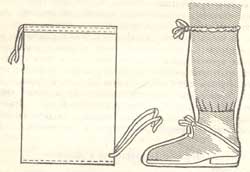 Rice. 2. Shoe covers for ski boots.
Ski boots should have a high top, a wide toe box and be very full. Ski boots are taken two numbers larger than regular shoes and put on 2-3 woolen socks. Boots are equipped with thick (possibly fur) insoles. It is recommended to tie the mittens together with a braid that is pulled through the sleeves of the storm jacket.
Skis. The most comfortable are wide tourist ones (7-9 cm). They are selected according to the rule: the toe of a ski placed vertically should reach the wrist of an outstretched hand. More precisely (taking into account the difference in the build of people), the length of the skis can be determined by the figure that is obtained if half of his weight in kilograms is added to a person’s height in centimeters.
In mountainous areas or when moving on hard crust, edged skis with a wooden sliding surface are good. Semi-rigid fastenings are used, preferably with a cable (the so-called universal ones), metal sticks and rings are recommended for them.
GROUP EQUIPMENT
General list
(based on a group of 6-8 people)
| Designation | Number of pieces in travel | |||
| on foot | mountain | water | ski | |
| Gable tent | 2 | 2 | 2 | - |
| Insulated tent | 1 | |||
| Awning, polyethylene film | 2 | 2 | 2 | - 1 |
| Set of three buckets (pans) from 5 to 8 l, in a case | 1 | 1 | 1 | 1 |
| Medium ax in case | 1-2 | 1 | 2-3* | 2 |
| Small ax in a case | 1 | 1 | 1 | "1 |
| Two-handed saw in a case | 1* | - | 1 | 1* |
| Metal flyers, rope, hooks for hanging dishes, etc. | set | set | set | set |
| Fire mittens | 1 | - | 1 | 1 |
| Frying pan | 1 | - | 1 | - |
| Pouring spoon | 1 | 1 | 1 | 1 |
| Can opener | 1 | 1 | 1 | 1 |
| Flask | 2-3 | 2-3 | 2-3 | 2-3 |
| Thermos | - | - | 1—2* | 2-3 |
| Oilcloth for dining (polyethylene) | 1 | - | 1 | - |
| Nylon washcloth | 2 | 2 | 2 | 2 |
| Bezmen | 1* | - | 1* | - |
| Containers for food (bag with ribbons) | set | set | set | set |
| Laundry soap | 1 | 1 | 1 | 1 |
| Matches in waterproof packaging | 3 | 3 | 3 | 3 |
| Tablet (with paper, tracing paper, pencil) | 1 | 1 | 1 | 1 |
| Maps, documents, copies (set) | 2 | 2 | 2 | 2 |
| Signal whistle | 2-3 | 2-3 | 2-3 | 2-3 |
| Pocket flashlight with batteries | 3 | 3 | 3 | 3 |
| Spare set of batteries | 3 | 3 | 3 | 3 |
| Spare bulb for flashlights | 3-5 | 3-5 | 3-5 | 3-5 |
| Stearic candle | 3-4 | 3-4 | 5 | 5 |
| Candlestick for candles | 2 | 2 | 2 | 1 |
| Razor with set of blades and mirror | 1 | 1 | 1 | 1 |
| Spare safety glasses | - | 2 | - | 1 |
| Medical kit | according to the list (see item 45) | |||
| Repair kit | according to the list (see p. 53) | |||
| Fishing tackle (set) | 1 | - | 2-3 | - |
| Photo and cinema cameras, accessories and materials | according to the list (see 0. 203) | |||
| Binoculars with rangefinder | - | 1 | 1* | - |
| Boat, kayak, raft (with life-saving equipment and spare parts) | - | - | 2-4 | - |
| Main rope (30-40 m) | 1* | 1-2 | 1* | - |
| Auxiliary rope (30-40 m) | 1 | 1 | 1 | 1 |
| Repshnur (Abalakov belt) | 2-3 | 2-3 | 2-3* | - |
| Mountaineering carabiner | 2-3 | 2-3 | 2-3* | 1 |
| Cats with wicks in a case | - | 2-3* | - | - |
| Hooks | - | 4-8* | - | - |
| Rock hammer | - | 1* | - | - |
| Primus tourist (gasoline stove) with a set of needles, keys, gaskets, etc. | - | 2-3* | - | - |
| Camping stove with cover | - | - | - | 1* |
| Fuel container (canisters, flasks) | - | 1-3* | - | - |
| Fuel (gasoline, dry alcohol in kg) | - | 2-4* | - | 1-2* |
| Avalanche shovel (dural sheet) | - | 1 | 1 | |
| The shovel is competitive | 1 | - | - | - |
| Spare ski | - | - | - | 1-2 |
| Spare ski bindings | - | - | - | 2-3 |
| Valenki (for duty officers) | - | - | - | 2 |
| Set of ski waxes | - | - | - | set |
| Stopper for rubbing ointment | - | - | - | 2 |
| Ointment for impregnating shoes | - | 1 | - | 1 |
| Large syringe (for kayak) | - | - | 3-4* | - |
| Songwriter | 1-2* | 1-2* | 1-2* | 1-2* |
| Musical instrument | 1* | 1* | 1* | 1* |
| Volleyball | 1* | - | 1* | - |
| Badminton | 1* | - | 1* | - |
| Observation instruments (thermometer, anemometer, snow gauge, etc.) | * | * | * | * |
| Determinants (plants, minerals, etc.) | * | * | * | * |
| Protractor | 1 | 1 | 1 | 1 |
| Curvimeter | 1 | 1 | 1 | 1 |
| Pedometer | 1* | 1* | - | - |
| Alidad | 1 | 1 | 1 | 1 |
| Meter (compass) | 1* | 1* | 1* | 1* |
• It is taken depending on the specific travel conditions at the discretion of the group.
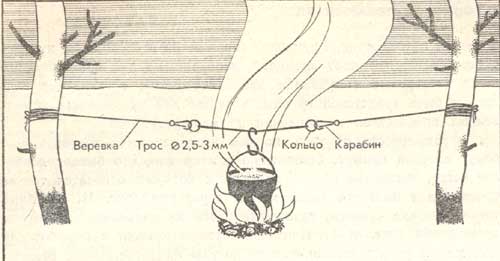 Rice. 3. A fire between two trees.
Features of group equipment for hiking and mountain travel
On foot. Group equipment for a simple trip usually includes items necessary for cooking (fireplace and kitchen utensils), organizing overnight accommodation and living conditions for the tourist group, as well as for overcoming natural obstacles and moving along the route.
Depending on what you plan to cook food on, you take with you a primus stove, a gasoline stove, or, what happens most often, fire equipment, which includes thin ropes for hanging buckets between trees (Fig. 3), folding tags, light tripods, collapsible hearths made of metal rods, brackets (Fig. 4-5). Hooks and chains are also used for hanging and adjusting the height of dishes above the fire (Fig. 6), windproof and heat-reflective screens for primus stoves and alcohol kitchens, and metal meshes (such as hammocks) for making a fire above the ground.
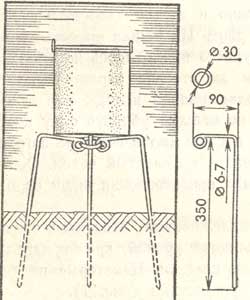 Rice. 4. Tripod for fire.
The most convenient type of group dishes for carrying is a set of two or three “flat” buckets or pans with an oval (in plan) bottom that can be stacked one inside the other. Their total capacity should be such that each tourist receives 1.5-2 liters. For buckets, pots or kettles, it is advisable to make in advance removable wire arms for hanging dishes over the fire or metal chains that do not interfere with putting one dish into another. For each cooking utensil (to avoid contamination of the backpack and things) you should make a cloth cover. Galvanized or enameled buckets are not suitable for cooking over a campfire.
Kitchen and campfire utensils also include a pouring spoon, a stirrer with a long handle, a chapel hook, a pair of canvas mittens, and a piece of oilcloth. Some of these items can be made while traveling (Fig. 7).
Among tents, preference is best given to lightweight gable ones with a collapsible frame. If for some reason the tent is not equipped with collapsible poles, then they should be made from pieces of duralumin tubes with a diameter of 1-1.5 cm and a length of 40-45 cm. To avoid damage to the trees, the tent should also include pegs (pins) made of a thin metal rod or corners. To prevent the pegs from getting lost or torn during transportation, they are put in a case. A cover is also desirable for the entire tent: it is put there if it is removed undried after rain or, conversely, if it is transported outside the backpack in wet weather.
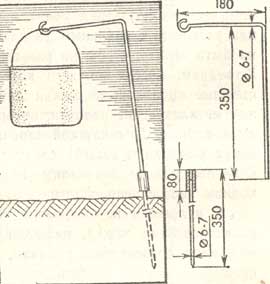 Rice. 5. Bracket for fire.
Despite the fact that the roof of the tents is made of fabrics with water-repellent impregnation, in bad weather you should cover the tent with plastic film. It is desirable that this cape be large enough to cover not only the tent, but also the backpacks placed near it. To do this, you can connect several pieces of polyethylene together using an iron or soldering iron. It’s even better to have a lightweight tent-roof made of rubberized nylon.
When traveling to areas with a warm, low-rainfall climate, an awning measuring 3x2.5 m can replace two tents for a group of 6-8 people. Loops are inserted into the corners and in the middle of the long sides of the awning, to which strong cords are tied for stretching. The awning should be stretched obliquely with a height of the upper edge of about 2 m. A fire is built about three meters in front of the awning.
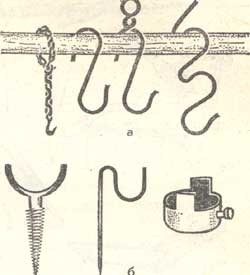 Rice. 6. Homemade fire equipment: A - adjustable chain and hooks; b - metal flyers.
Of the axes, the most convenient is the carpenter's axe, sharpened for cutting down trees. The most important requirement is a good, securely wedged ax attachment on the ax handle (length 50-60 cm). Tourist (hunting) all-metal hatchets with a rubber handle have also proven themselves well.
Among the equipment needed when overcoming natural obstacles, you need to have with you an auxiliary rope (30-40 m), several cords and carabiners. Among other equipment, it is also useful to take bags with ribbons for food, laundry soap, candles, nylon sponges, covers for utensils, saws, etc.
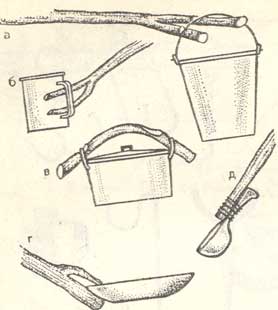 Rice. 7. Accessories for a camp kitchen: a - handle for removing the bucket; b — handle for a mug; c - handle for a pan; g - frying pan; d - handle for ladle
On a mountain journey. Collective equipment for a mountain trip, in addition to the set for a hiking route, includes a rope, pitons, climbing crampons, a rock hammer for passing difficult areas, and for a long stay in the treeless area - a primus stove (Tourist or Bumblebee) and containers for liquid fuel. For a relatively short stay in a high mountain zone, you can limit yourself to a small supply of dry alcohol.
When traveling, it is advisable to have binoculars, an avalanche shovel (in the snow it is used as a support for a kerosene stove), and a spare pair of sunglasses. Instead of buckets, it is better to take a set of three pans.
To save weight and insulate overnight stays, it is recommended to use multi-person (2-4 people) sleeping bags.