

Auto tour in Alaska - a classic route covering the main attractions: national parks, glaciers, fjords, gold mines. You can travel in motorhomes (more comfortable) or in cars (cheaper).
Travel map
Program by day
RouteRoute map
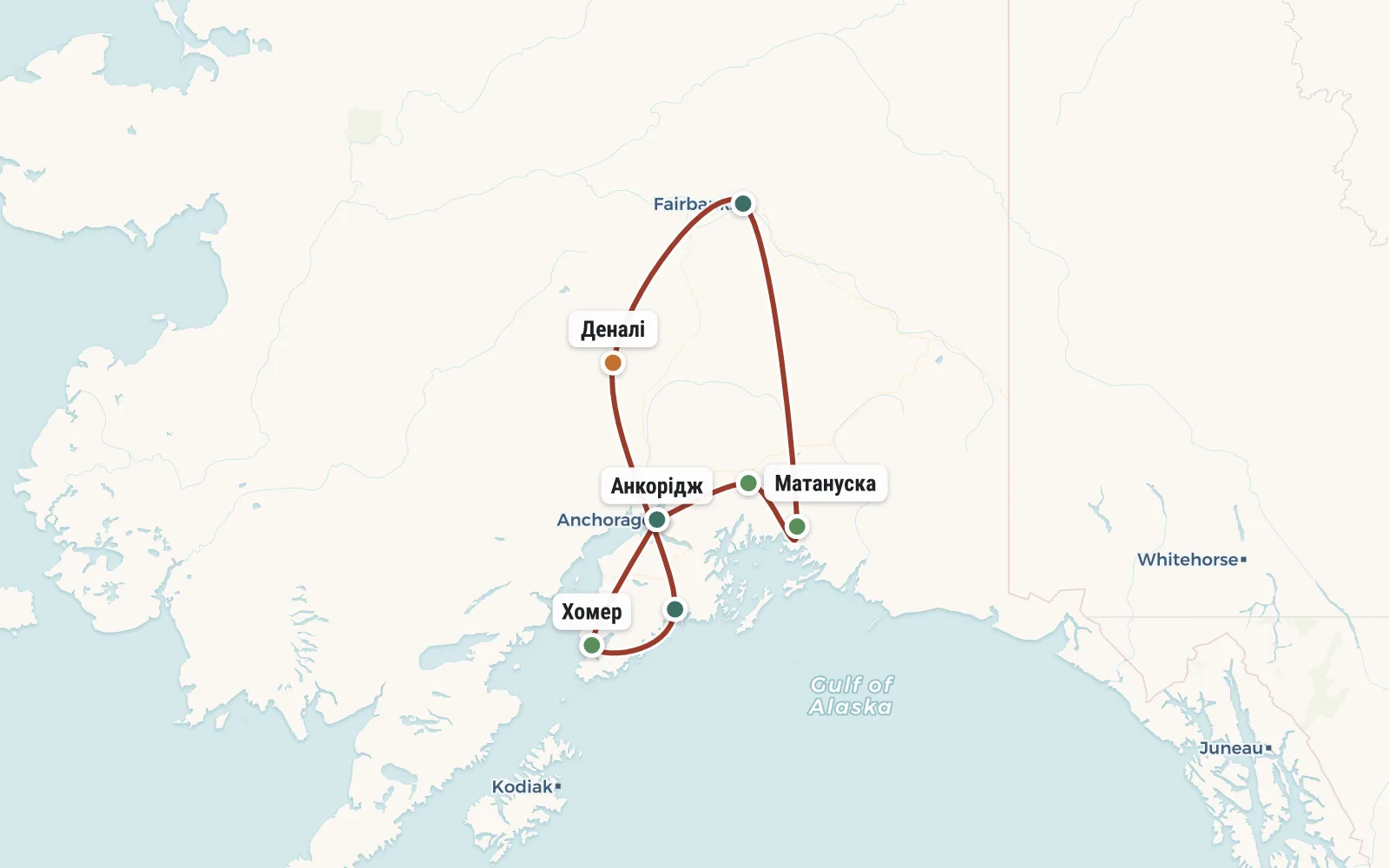 Open the map →
The GPS track is not digitised yet, the line is approximate (by key points).
Along the trailWhat you will see


Day by dayItinerary
1 Day 1. Anchorage
Group meeting in Anchorage in the afternoon. We rent a car and literally symbolically look into the city center - a square, a museum (if desired, 20 dollars). We go to the supermarket for groceries and leave the city. The further we travel from Anchorage today, the longer we can sleep tomorrow. We spend the night at the campsite.


2 Day 2. Matanuska Glacier, Worthington Glacier, Valdez
We break camp early and drive to the Matanuska Glacier in about 2 hours. Here at 9 am a walking tour on the glacier begins (2-3 hours, 100 dollars) with a local guide and wearing crampons. Upon completion, we get into the car again - another 3 hours on the road and we are at the Worthington glacier. We also walk here, but without a guide and without access to the ice. From the glacier it’s literally half an hour to the port town of Valdez. Overnight at the campsite, walk to the port.


3 Day 3. Fjord cruise
We leave our things and cars at the campsites and go to sea for the whole day. We are waiting for a cruise through the Alaskan fjords (8 hours, 170 dollars) - through the Valdez Arm Strait and Unakwik Inlet we go to the Meares glacier, which flows directly into the ocean. Along the way we see whales, killer whales, sea lions, sea otters, puffins and other marine life. In the evening we return to Valdez and spend the night.


4 Day 4. Alaska Range, North Pole
Today we have the biggest stretch of the entire trip - we are going deep into Alaska. The main attraction of the day is the Alaska Range, which we cross. We make a lot of photo stops at observation platforms. In the evening we reach a town with the modest name North Pole. And of course there is the residence of Santa Claus. We buy souvenirs and go to the campsite.


5 Day 5. Fairbanks, Gold Rush, Hot Springs
Spend most of the day exploring the charming town of Fairbanks, closely associated with the Gold Rush. We'll see a paddle steamer (you can take a ride), ride on an old narrow-gauge railway, pan for gold in a stream (50 dollars) and get acquainted with the culture of the local Athabaskan Indians. The local Pioneer Park contains numerous exhibits related to the history of Alaska, and there is simply something to see. In the evening we go to Chena Hot Springs, 15 dollars. There is also an ice museum there (15 dollars). Overnight at the campsite.


6 Day 6. Road to Denali
Finally we go to Denali National Park - the main highlight of our trip. Denali, or McKinley, is the highest peak in North America (6190 m) and simply a very beautiful mountain. When we get to the entrance to the national park, we will book tickets for tomorrow’s flight to the reserve, and then go on a short trek through the foothills. We'll go to Horseshoe Lake and Mount Healy (1742 m) for beautiful views. Overnight at a campsite near the border of the national park.


7 Day 7. Denali National Park
We leave the cars and go to Denali National Park for the whole day. You can travel here only on special buses. They make stops at observation platforms, give way to wild animals (bears, wolves, deer, moose) and generally provide an excellent platform for observing nature. Especially if you understand English - there is a ranger on the bus who talks a lot about the park and the habits of its inhabitants. Having arrived at the far end of the park, we may decide to take a short walk around the area, for example to Wonder lake. As the park closes, we take the return bus and return to the campsite.


8 Day 8. Airplane to Denali Glacier
Early in the morning we move to the village of Talkeetna (2.5 hours on the road). Air tours to Mount McKinley take off from the local airfield. Small 4-seater airplanes can not only fly around the peak, but also land directly on the glacier (from 270 to 450 dollars, 1 hour). If you don’t want to fly, you can go fishing (from 15 to 200 dollars) or ride an ATV. When everyone returns, we get into the car and drive to Anchorage until the evening.


9 Day 9. Portage Glacier, Whittier, Exit Glacier, Steward, Alaska SeaLife Center
In the morning we go to the Portage Glacier and through the original road-railway tunnel we break into the town of Whittier. If we have time, we’ll go for a walk to the Emerald Cove forest lake. Then we dive into the tunnel again and rush to the new Exit glacier. A short photo session and we head down to the town of Seward. We go to the Alaska SeaLife Center aquarium (30 dollars) where you can get a little closer to sea lions, puffins, otters and see how they behave under water.


10 Day 10. Cook Inlet, Homer, Kachemak Bay
Depending on the weather, mood and the time of tomorrow's flight, we have several options for the future. If we are in the mood for adventure, then we can get in the car and drive 4 hours to visit the shores of Cook Inlet and see another cute northern town - Homer. It is believed that there are especially many bald eagles here (the eagle from the US coat of arms). But then tomorrow we will have to spend more time returning to Anchorage (wake up earlier). Or you can stay in Seward and go on another sea cruise on a ship in Kenai Fjords National Park (170 dollars) or rent kayaks (95 dollars) and swim with otters in Resurrection Bay.


11 Day 11. Anchorage, plane
No matter where we wake up, we need to get back to Anchorage before noon, return the car and rush to the airport. Immediately after Alaska, we begin drive tour of the Northwest USA (Washington and Oregon states, Cascade Mountains and Pacific beaches). The adventure continues! Join us :)


DetailsIncluded
- 🧭Guide services
- •Car or motor home rental
- •Petrol
- •Parking
- 🏨Paid campsites
Not included
- ✕Air flight to Alaska - from 900 dollars
- ✕Food - from 100 dollars
- ✕Local entertainment (cruises, excursions, museums, tours, national parks) - about 800 dollars
- ✕Car insurance franchise
- ✕Medical insurance
Trip conditions
There are three main travel format options in Alaska. Each of them has its own pros and cons. Let's look at them in more detail:
Car + tent - the most budget option. We rent a car or minibus and drive around Alaska in it. We spend the night in tents in organized paid campsites. Advantages: low cost, maximum flexibility and the ability to change the route and dates (no need to book anything), good visibility in the car. Disadvantages: it can be chilly in the tent, the possibility of encountering a bear may be scary for some, not all campsites have showers (toilets are available everywhere). Food is store-bought - almost every day we go to the supermarket, buy food together or separately and cook it at the campsite on a camp burner.
Motorhome. This is a huge 10-meter cuttlefish - a whole bus inside of which there are sleeping places for 4-8 people, a kitchen, shower and toilet, heating and an electric generator. Advantages: warm, dry, not afraid of bears. Disadvantages: slowness and clumsiness on the road, not the most familiar seating position for passengers relative to the windows, cramped conditions and lack of personal space in parking lots. Imagine, 6 people live together almost 24 hours a day in 20 sq.m. They eat, sleep, travel together. The food is the same as in the previous version, only we cook not on the street, but in a motor home. In addition to a gas stove, there is usually a refrigerator and a microwave, and a water tap.
Car + hotels - the most expensive and least flexible option. The choice of hotels is only in large cities like Anchorage or Fairbanks. And there they cost a double room in a three-star hotel ranging from 130 to 250 dollars. But once you move a little deeper into Alaska, there are much fewer housing options, and prices start at $200 per room. And most importantly, hotel rooms are quickly snapped up. At the height of the season you won’t be able to book anything spontaneously. Combined meals: restaurants + shops.


