
Organization of an amateur trip
Tourism is the most widespread form of active recreation and recreation for workers, one of the important means of educating Soviet people. During their travels, tourists get acquainted with the past and present of our Motherland, its natural resources, cultural monuments, perform socially useful work, observe nature, and protect it.
According to the nature of the organization, trips are divided into planned and amateur. Planned ones are carried out along a route developed in advance and prepared by some organization, with the provision of all kinds of services and accommodation at tourist centers and hotels. In amateur travel, tourists are in complete self-service, they themselves decide all issues related to choosing a route, providing equipment, developing a travel schedule, etc. A properly organized and conducted amateur tourist trip provides good rest, physical development and sports improvement of tourists, broadens their horizons, fosters collectivism, love of nature, discipline, courage and initiative.
Hiking trips are an integral part of the All-Union physical education complex “Ready for Labor and Defense of the USSR.”
The procedure for organizing travel is determined by the Rules for organizing and conducting amateur tourist trips and trips on the territory of the USSR, which are approved by the Central Council for Tourism and Excursions of the All-Union Central Council of Trade Unions and agreed with the Union Ministries of Internal Affairs, Health, Education, Geology and other interested departments and central organizations.
In accordance with these Rules, amateur tourist travel can be carried out by tourism and excursion councils, committees on physical culture and sports, councils of voluntary sports societies (VSSO), tourist sports clubs, physical culture groups of enterprises, collective farms, state farms, organizations, institutions, educational institutions, recreational tourist and sports camps, stations for young tourists, secondary schools. Palaces and Houses of Pioneers and Schoolchildren.
The current Unified All-Union Sports Classification divides travel into several types depending on the method of travel and the conditions under which it is carried out. The most popular of them are hiking, water, skiing and mountain.
In order of increasing complexity, amateur tourist trips are divided into weekend trips and multi-day trips of I, II, III, IV, V and VI categories of complexity.
The determination of the category of complexity of multi-day trips is made by public tourist route qualification commissions (ICC) depending on the following indicators (for categories I-III of complexity):
| Indicators | Hiking difficulty categories | ||
| I | II | III | |
| Duration of hikes in days (not less) | 6 | 8 | 10 |
| Hiking length in kilometers (not less): | |||
| pedestrian | 130 | 160 | 190 |
| ski | 130 | 160 | 200 |
| mountain | 100 | 120 | 140 |
| water (on rafts and rowing boats) | 150 | 175 | 200 |
The duration of hikes is indicated without taking into account rest days and reserve days for bad weather. Although the maximum duration is not specified, if the number of days turns out to be significantly more than the standard without sufficient grounds, then the IWC has the right to reduce the qualifying difficulty of the hike due to insufficient intensity of the load.
The length of the route is calculated taking into account radial exits if they do not exceed a quarter of the total length of the hike. In this case, a radial exit is considered to be a section of the route lasting no more than four walking days with a return to the starting point. Distances traveled in circular radial exits (with a return along a different path) are counted in full; distances traveled in linear radial exits (with a return along the same path) are counted in half.
A prerequisite for determining the category of difficulty of hikes is their compliance with the lists of classified tourist routes and classified passes approved by the Tourism Federation of the Central Council for Tourism and Excursions. These lists contain the main criterion for determining complexity - the number and quality of natural obstacles on the routes.
Each type of tourism takes into account certain types of natural obstacles. For mountain trips, the category of difficulty is determined taking into account the set of passes:
| Hiking difficulty category | Total number of passes | Number of mountain passes that determine the difficulty of hikes (by category of difficulty) | ||
| 1А | 1Б | 2А | ||
| 1 | 2 | 2 | ||
| 2 | 3 | 1 | 2 | |
| 3 | 4 | 1 | 2 |
COMPLETING A GROUP AND PREPARING FOR THE TRIP
A tourist group should be a monolithic team, each of whose members is united with others through friendship and unity of purpose. Therefore, it is desirable that all tourists in the group have approximately the same age and physical fitness, similar skills and knowledge, and similar interests.
It is recommended that the group be composed of tourists working at the same enterprise, institution or studying at the same school, technical school, or institute. Such groups are the most homogeneous and stable, they are easier to organize and provide with equipment.
Prefabricated tourist groups are also common, uniting people with common interests or assembled according to some other characteristics.
The number of members of a tourist group taking part in a weekend trip is not limited. Tourist groups going on routes I-III categories of difficulty must consist of at least four people.
Requirements for travel leaders and participants:
Leaders of amateur travel. They are chosen by tourists and approved by travel organizations.
Leaders must be politically literate, cultural, strong-willed, physically developed people with organizational abilities and the necessary tourism skills. They are obliged to observe safety measures and be ready to provide the necessary assistance to their comrades, monitor the careful attitude of tourists towards nature, and tactful behavior. towards local residents.
Travel leaders of complexity category I must have experience leading weekend trips, and trip leaders of complexity categories II and above must have experience leading a trip one category lower and experience participating in a trip of the same complexity category for this type of tourism. So, if a group is going on a ski trip of category III difficulty, then it can only be led by someone who has already completed a ski route of similar complexity as a participant and, in addition, has experience leading a ski trip of category II difficulty.
Group leaders are responsible for the preparation and trouble-free conduct of trips. Instructions from group leaders during travel are mandatory for all group members.
The group leader can be a tourist who has reached the age of 18.
Participants of amateur trips. Approved by travel agencies.
All participants in trips of difficulty category I must have experience of weekend hikes.
The group for travel of categories II and III of complexity includes mainly those who already have travel experience of categories I and II, respectively, for the same type of tourism. Due to the fact that it is sometimes difficult to select an even composition of the group, the current rules allow participation in a trip of category II difficulty by beginner tourists with experience of weekend hikes, and in a trip of category III - tourists with travel experience of category I. However, the number of those who have such insignificant tourist experience should not exceed one third of all tourists in the group.
In the event of a temporary division of a group on the route, in each subgroup (and in water travel - on each ship), senior officers are allocated to ensure coordinated actions of tourists and their compliance with the instructions of the group leader.
All participants in category trips, regardless of the type of tourism, must be able to swim, know the techniques of rescuing drowning people and be able to provide first aid.
Participants who are no younger than 14 years old are allowed to travel on routes of the first category of difficulty, no younger than 15 years old on routes of the second category of difficulty, and no younger than 16 years old on routes of the third category of difficulty.
Additional Requirements
Depending on the specifics of water, ski and mountain travel, additional requirements are imposed on participants and leaders.
The leader of a water trip must have experience leading trips on the same type of water tourism (raft or rowing vessel - kayak, boat).
Participants in ski trips of II and III difficulty categories must have experience of field overnight stays in winter conditions. Moreover, field overnight stays mean overnight stays outside populated areas: in tents, under an awning, around a fire, in a hut, in a snow cave, hunting huts, etc.
Participants and leaders of mountain trips of I-III categories of difficulty, which involve crossing high-mountain (classified) passes, must have special training:
a) if there are passes of IA category of difficulty on the route, then the group members must undergo pre-camp training for the “USSR Mountaineer” badge, and the leader must have the “USSR Mountaineer” badge or training in the scope of a special part of the program for mountain tourism instructors and experience in passing two passes of IA category of difficulty;
b) if there are passes of category 1B of difficulty on the route, then the group members must have the “USSR Climber” badge or training in the scope of a special part of the program for mountain tourism instructors and experience in passing a pass of category IA, and the leader must have additional experience in passing, as a participant in a hike, pass 1B and as a leader: a pass of category IA of difficulty;
c) if there are passes of category 2A of difficulty on the route, then the group members must, in addition to the experience of overcoming passes 1B, have experience of passing pass 1B of category of difficulty, and the leader must additionally have experience of passing pass 2A as a group member and pass 1B of category of difficulty as a leader.
Distribution of responsibilities
The distribution of social responsibilities in the group is carried out taking into account the tourist experience of the participants, their practical skills, and interest in carrying out certain assignments.
Group leader. Leads the preparation and conduct of the trip, organizes the activities of other participants, is responsible for their safety and successful completion of the route.
Deputy leader. Usually this is the second most experienced tourist in the group. He is the chief assistant to the leader in all matters, and in his absence (for example, at certain stages in preparation for a trip or when temporarily dividing a group on a route) he is the leader of the group.
The manager of the household (the caretaker). Distributes responsibilities for preparing food and equipment among the participants, places them in backpacks, keeps records of food and equipment along the route, takes care of their condition and replenishment, and draws up a menu.
Sanitary instructor. Before traveling, undergoes special training in providing first aid, completes and stores a traveling first aid kit, monitors tourists’ compliance with sanitary and hygienic requirements, and provides first aid if necessary.
Responsible for the diary. Keeps a record of marching events, compiles the timing of marching days.
When there is a large group (more than 8-10 people) or on a difficult route, it is customary to additionally select from among the participants a treasurer, a photographer responsible for repairing equipment (repairman), a physical engineer, etc.
When carrying out certain scientific observations while traveling, responsibilities are distributed among tourists according to the types of observations. Those responsible for topographic surveying, collecting samples for the mineralogical collection, meteorological observations, etc. are identified.
In addition, responsibilities in a group can be temporary: for one day, a transition, or some kind of hiking event. These are those on duty in the kitchen, firemen, guides and trail runners, responsible for holding a tourist evening, competitions, organizing excursions, and reconnaissance of the further route.
The main thing when distributing responsibilities is not to deprive group members of useful initiative, give more personal tasks, and increase the personal responsibility of group members.
General physical and special preparation for travel
General physical training of tourists. Includes morning exercises, passing the standards of the GTO complex and exercises (training) during weekend hikes. It’s good if tourists are involved in one of the sports sections - athletics, skiing, etc.
In parallel with physical training, hardening of the body of tourists should be carried out. Air hardening occurs during morning exercises, which tourists should do in any weather and at any time of the year outdoors. After charging, water procedures are required.
Special preparation. Necessary for those who are preparing for a more or less difficult trip, especially mountain, ski or water travel.
Specific exercises depend on the intended route. If you are planning a kayaking trip, then your morning exercises include slow and fast bending of the body from various positions, raising and lowering your legs while lying down, push-ups, and exercises simulating rowing. If you are preparing for a ski trip, then your exercises include long running, walking, simulating skiing, exercises to build up the strength of your arms, abdominals, and to develop mobility in the hip and shoulder joints.
For those planning a mountain trip, it is advisable to practice jumping over bumps (stones), balancing with a load on a log, walking on full feet on steep slopes, deep jumps with landing on an inclined sandy slope, and “rock climbing” with belay.
Both special and general physical training are carried out in the form of joint classes of all participants in the planned trip. This helps strengthen the team and develops a sense of “similarity” between group members.
To check physical readiness for a trip of I-III difficulty categories, it is recommended to use the following control standards:
| Standard | Rating | ||
| satisfactory | good | excellent | |
| 100m sprint (seconds): Men Women | 14.8 17.5 | 14,6 17,0 | 14,0 16.0 |
| Single leg squat (times): Men Women | 10 5 | 15 10 | 20 15 |
| Pull-up bar (for men, times): | 8 | 9 | 10 |
| Push-up (for women, times): | 4 | 6 | 8 |
| Cross (min): Men 3 km: Women 1 km: | 13 5,5 | 12,5 4,5 | 12 4 |
| Ski (min): Men's 10 km Women 3 km | 70 26 | 65 25 | 60 24 |
Medical support for travel. Consists of organizing an appropriate medical examination of all group members (preferably by doctors from a medical and physical education clinic) before setting out on the route and preparing tourists, primarily the group’s medical instructor, to provide first aid.
Before the hike, tourists are advised to consult with medical specialists, reduce calluses, heal abrasions, dental and other diseases, and also keep a special diary to monitor their health.
When determining the possibility of participating in a hike of I-III categories of difficulty after some acute illnesses, you need to focus on the following approximate dates:
| Name of disease | Time after clinical recovery | Notes |
| Sore throat | 3-4 weeks | |
| ARI, bronchitis | 2-3 weeks | |
| Acute otitis media | 2-4 weeks | |
| Pneumonia | 1-2 months | Only allowed at first day hikes |
| Pleurisy | 1-2 months | Same |
| Influenza (without complications) | 2-4 weeks | |
| Acute infectious diseases | 1-2 months | With satisfactory test results |
| Infectious hepatitis | 8-12 months | |
| Acute nephritis | 8-12 months | Controlled urine tests are required |
| Bone fractures of the extremities: upper lower | 1-3 months 3-8 months | Depending on the severity of the injury |
| Concussion | 8-12 months or more | Same |
ROUTE DEVELOPMENT AND TRAVEL SCHEDULE
Each group, preparing for a campaign, must first of all have a good idea of its purpose, its main task. This can be a vacation with minor physical activity, searching for “untraveled” places with hunting and fishing, sightseeing, completing tasks of the organization, completing a sports route, etc. Having determined the goal, the actual physical and technical preparedness of the participants, as well as the financial and other capabilities of the group, tourists begin to study the area and develop a route.
Exploring the travel area
Studying the area includes: acquaintance with literature (including fiction), cartographic material, conversations with people who have visited the places of travel. It is also useful to take advantage of tourist reports and make notes about the relief, hydrography, climate, vegetation, wildlife, history, economics and everyday life of the population. A lot of valuable information, especially about specific attractions along the route, can be gleaned from correspondence with local tourism and excursion councils, tourist clubs, and individual local historians.
Working with maps occupies a special place in the process of preparing for a trip (see p. 110). By deciphering symbols, carefully measuring distances and compiling elevation elevations, tourists become familiar with the terrain's passability conditions.
Beginning tourists are recommended to use literature and maps to compile a detailed description of the route indicating distances; features of the terrain through which the route runs; with characteristics of roads; with a description of landmarks that will be visible near and far from different points, etc. Such a description will make it possible to move confidently without constantly checking the map.
Route development
The construction of the route depends on the specifics of the trip and the specific conditions of the area. It can be linear (end-to-end), linear-radial with long excursions or reconnaissance exits away from the main path, circular with a return to the starting point of the path. When planning a route, it is necessary to ensure a gradual increase in the complexity of natural obstacles and an increase in the interest of travelers in the second third of the journey. It is advisable to reserve for this part the technically most difficult sections, visits to the most interesting museums, panoramic points and other interesting objects.
The hiking route should be built in such a way as to reduce hiking loads as much as possible. It is recommended to identify points in advance where you can send some equipment and food by mail or where you can replenish your supplies. It is also advisable to create base camps from which various radial journeys can be made with minimal load. In addition to the main route, it is necessary to have a lightweight backup option in case one of them gets sick. participants, bad weather, river floods, increased avalanche danger, etc.
The route must be safe and logical. An artificial set of certain obstacles and excessive “twisting” of the path will not give tourists satisfaction and can lead to injuries.
Drawing up a calendar plan
The travel calendar, traffic schedule and calculation of daily transitions are developed depending on the complexity of the path, the physical and technical preparedness of the group members, the weight of the backpacks, as well as the presence of certain excursion sites that require stops to inspect.
While traveling on foot. On average, tourists walk 15–25 km per day. If the backpack is heavy (especially in the first days of the trip) or the route goes over rough terrain with overcoming natural obstacles, and also if the group includes poorly prepared beginners, the day's trek should be reduced to 12-18 km. The increase in loads should be gradual. So, on a hiking trip of I-II category of difficulty, the daily mileage can be as follows: 15, 18, 20, 22 km, day trip, 22, 25, 25, 18 km. If the route profile is difficult, the second or third day of the hike is the hardest. Therefore, it is better not to increase the mileage in the first three days, but to take a day’s rest on the fourth day.
On a ski trip. On the ski track, even novice tourists can travel 20-30 km a day with relative ease. When moving on virgin snow with overcoming natural obstacles or in conditions of difficult orientation, the speed drops to 12-18 km per day. The pace of movement is seriously reduced during a thaw, and it is generally better to wait out a snowstorm, sudden cold snap, or strong headwind in a populated area. Therefore, up to 1/4-1/5 of the total time on a winter hike is planned as reserve time. left for unforeseen delays along the way.
On a mountain trip. The time required for the ascent is determined by summing up the estimated time spent moving the group horizontally (average speed 3-4.5 km per hour) and ascending vertically (speed about 0.3-0.4 km per hour). The duration of the descent along a simple path is calculated based on a speed of 5-6 km per hour. When planning transitions, we must not forget about the possibility of worsening weather.
On a water trip. In addition to the total mileage, the number and quality of obstacles, excursion sites available on the route, and the necessary reserve of days for bad weather, when developing a calendar plan, such specific indicators as the slope and tortuosity of the river, and the speed of its flow are taken into account. And not only the average for the entire route, but also for its individual sections. With a river slope of up to 1 m/km (0.001) and a current speed of 4-5 km per hour, the speed of movement of tourists will be slightly less than the sum of the speed of the current and their own speed. As the slope and flow speed increase, the speed of the group may not increase, since a lot of time will be required to preview obstacles and prevent emergency situations (novice tourists should not walk on such rivers).
The actual speed of movement on oars or a towline against the current is 1-2 km per hour (with a slope of up to 1-1.5 m/km), and it takes about an hour to overcome an obstacle on a flat river that requires guiding or carrying around. On average, for calculations, we can assume that the speed of a tourist vessel on a voyage of I-II difficulty categories is 4-5 km per hour.
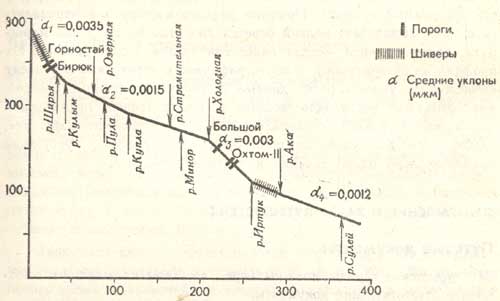 Rice. 1. Profile of the water route (data are conditional).
Route profile. When preparing a water, mountain or ski route, even the simplest one, it is useful to build its longitudinal profile. The profile of the water route is drawn on two scales: a small scale is taken to mark the length of the route, a larger scale is taken to mark the water edges (Fig. 1). Calculated slopes of the river, data on the nature of the valley, banks, and bottom are transferred to the profile from literary and cartographic sources, and places of natural and artificial obstacles are noted. This allows you to really assess the features and complexity of the route, to break it down for ease of passage into sections that require approximately the same technique and movement tactics.
REGISTRATION AND ACCOUNTING OF TRAVEL documents
All tourist groups must complete the appropriate documents before setting out on the route.
Route sheet. This is a travel document for a group setting off on an amateur trip, less difficult than a first category hike. Itinerary sheets of the established form are issued to ICC tourists and signed by the head of the organization (or his deputy) conducting a non-category trip or weekend trip.
The route list includes a list of travel participants, a route broken down by sections, indicating methods of transportation and socially useful work that the group plans to carry out along the way.
At the end of the trip, the itinerary is returned to the organization that issued it.
Route book. Travel document for a group going on a trip of I and higher complexity categories.
The book contains the roster of the group with passport data for each participant, a detailed calendar plan for the trip by days of travel, checkpoints and deadlines for submitting telegrams from the route. The book is issued to the group leader only after the ICC has checked the correctness of the developed route and the preparedness of tourists for it.
Review and approval of the route
A tourist group preparing for a trip of I and higher categories of complexity, in order to receive a route book, submits to the ICC an application book containing basic data about the route of the intended trip, information about the composition of the group, the experience of tourists, material support (equipment, food, first aid kit, estimate), difficult sections on the route and methods of passing them. The application book is certified by the organization conducting the trip, and for national groups - by the tourist club, the council for tourism and excursions, DSO, etc.
The application booklet is submitted to the local ICC no later than a month before the start of the trip. If this commission does not have the necessary powers, then the booklet is sent to a higher ICC, but also no later than a month before the trip.
The ICC is obliged to check the development of the route and traffic schedule for the main and alternate options, the knowledge of the route leader and participants of travel conditions and natural obstacles, the correctness of the measures planned by the group in case of unforeseen deviations from the route and traffic schedule, and measures to ensure travel safety. In the process of reviewing the route, all participants in the planned trip can be called for a conversation and control checks in the field can be assigned to them.
If the decision is positive, the ICC, no later than 15 days before the start of the trip, issues to the group leader a numbered registered form of the route book, certified by the ICC stamp, and a copy of the application book with its conclusion.
At the same time, the MKK enters, if necessary, special instructions for the group into the route and application book, and notes in them the place of registration of the group before setting out on the route at the relevant control and rescue service (CRS).
Based on the conclusion of the ICC and medical certificates about the health status of all members of the group, the organization conducting the trip allows the group to go on the route and issues a route book with the signature of the responsible person of this organization and its seal.
Control over the preparation and conduct of the trip
The organization conducting the trip monitors the preparation and training of the group, equipping it with the necessary equipment, as well as the completion of the trip on time.
When conducting trips of II and higher categories of complexity, the organization conducting the trip must, no later than 10 days before the group leaves for the starting point of the route, inform the tourist office of the relevant council for tourism and excursions about the intended route and travel dates, checkpoints, the name of the leader and the number of group participants.
During the trip, tourist groups are required to make notes in the route books about the passage of the route in tourist, and in their absence in other organizations and institutions, report by telegraph about the passage of checkpoints of the organization conducting the trip, the ICC (at its request) and the council for tourism and excursions in the area of which the trip takes place.
If the trip takes place in an area where there is a tourist checkpoint, then upon arrival the group is required to register at the nearest control and rescue point (detachment, post) and receive additional advice on the route.
Report writing
During the trip, tourists keep a hiking diary and record the results of various observations along the route (for information on keeping a diary, see p. 205). At the end of the trip, the group leader reports to the organization that conducted the trip and the ICC within no more than 4 months.
Travel reports should generally contain the following sections:
1. Background information about the trip: type of tourism, category of difficulty, time, area, route, methods of transportation; composition of the group; the length and duration of the journey in general and in sections with overcoming natural obstacles; when and which IWC considered travel.
2. Information about the travel area: a brief general geographical description of the area; a tourist characteristic based on the group’s own observations and conclusions, materials collected by the group through correspondence and on the route, and aimed at providing subsequent tourist groups with specific information about the natural features of the area, sightseeing objects, roads, local transport, opportunities for replenishing food supplies, etc.
3. Technical description of the trip: characteristics of the route traveled, conditions and possibilities of movement; difficult sections of the route (passes, rapids, crossings, places with difficult orientation, etc.); methods and means used to overcome natural obstacles; security measures and group actions in difficult conditions.
4. A detailed table of daily marches indicating the mileage and method of movement, the number of walking hours, the mileage with overcoming natural obstacles and a brief description of the weather.
5. Lists of personal and group equipment and food, preferably with their assessment based on the experience of the trip.
6. Cost estimate.
7. List of used: literature.
The travel report is accompanied by a general map showing the route and overnight stays, as well as sketches of the most difficult sections indicating the route and timing of their completion.
The reports are illustrated with photographs characterizing difficult sections of the route and the group’s actions on them, the nature and attractions of the area, etc.
The specific volume and nature of the travel report of categories I-III of complexity, as well as the possibility of presenting it orally, are determined by the ICC. For school tour groups, a written report is required.
Travel credit and rank assignment
The completed trip is scored by the ICC, which reviewed the materials for the group’s departure on the route. A preliminary check is made of the report submitted by the group, as well as the tourists’ compliance with the current rules, norms of behavior or instructions of the commission during the trip.
When taking credit, completed trips are classified in accordance with current category standards and taking into account the conditions that existed during the trip.
Based on the route completion certificates issued to the leader and participants, they may be assigned one or another Sports category.
With a positive conclusion from an authorized ICC, the council for tourism and excursions, a tourist or sports club, the council of children's social activities or the physical education team, under which the ICC was created and operates, assigns a category to tourists in accordance with the following requirements (data are given up to the first category):
| Discharge | Hiking difficulty categories | Number of trips | |||||||
| I | II | III | IV | ||||||
| Participant | Supervisor | Participant | Supervisor | Participant | Supervisor | Participant | Supervisor | ||
| I | 1 | 1 | 1 | 1 | 1 | 1 | 1 | 7 | |
| II | 1 | 1 | 1 | 3 | |||||
| III | 1 | 1 | |||||||
| I youth (14-15 years old) | 1 | 1 | |||||||
| II youth (13-14 years old) | Complete one five-day hike or two (13-14 years old) three-day hikes with a total length of at least 65 kilometers | ||||||||
| III youth (12-13 years old) | Complete one three-day hike or two (12-13 years old) two-day hikes with a total length of at least 30 kilometers |
Hikes are counted regardless of what type of tourism they are made for. No more than three hikes are counted in a calendar year, unless they are higher than category III of difficulty. The interval between two qualifying trips must be at least a month.
To assign III, II and I sports categories, it is allowed to replace the leadership of hikes of I, II and III categories of difficulty with participation in hikes of III, IV and V categories of difficulty, respectively.
Hikes made along the same route, as well as repeated sections of routes, are counted if they are completed in different types of tourism or if the first time the hike was made as a participant, and the second time as a leader.
To be assigned categories III, II and I, it is necessary that tourists pass the standards of the GTO complex and are at least 14, 16 and 19 years old, respectively.
To be assigned a sports category (except for III and II youth), you must also have the “USSR Tourist” badge.
USSR Tourist Badge
The “Tourist of the USSR” badge is awarded to tourists who participated during the year in one or more trips with a total duration of at least 5 days and a total length of at least 75 kilometers on foot or skis, at least 100 kilometers on boats, kayaks, rafts, catamarans, at least 150 kilometers on bicycles or on horseback trails, at least 500 kilometers on motorcycles, 1,000 kilometers on cars (for drivers only). In very rough (mountainous) terrain, the standard for tourists hiking or skiing can be reduced, but not by more than 15 kilometers.
Persons who have a doctor’s permission to engage in physical education and who have reached the age of 14 are allowed to pass the standards for the “Tourist of the USSR” badge.
For schoolchildren, compliance with the norms is allowed for two years and only with the successive completion of five one- or two-day hikes with a total duration of at least 5 days and the total length indicated above.
When making hiking trips in the summer, participants must spend at least two overnight stays in the field.
The entry for the “USSR Tourist” badge is accepted by a commission consisting of at least three people (one third category athlete in tourism or a tourism instructor and two “USSR Tourist” badge holders).
Documents for the “Tourist of the USSR” badge are issued by tourist clubs, tourist sections of physical culture groups and military units, city (district) tourist clubs of tourism and excursion councils, tourist centers, stations of young tourists, Palaces (Houses) of pioneers and schoolchildren, secondary schools and other organizations carrying out tourist work and organizing tourist trips.